Category: Stocks

  • From Grinds to Gains: How Coffee Fuels the Modern Trader’s Mindset

    From Grinds to Gains: How Coffee Fuels the Modern Trader’s Mindset

    Waking Up to Opportunity
    The modern trading world never really sleeps—markets toggle from pre-market scans to after-hours swings, leaving little room for downtime. It’s no wonder coffee has become the unofficial lifeblood of traders everywhere. According to Healthline, caffeine can help enhance alertness, reaction times, and even short-term memory, all of which are crucial when you’re staring down a screenful of ticker symbols at 6 a.m. Nothing cements that early-morning ambition better than a quick shot of espresso paired with a metal riff in your earbuds.

    Coffee as Mental Rocket Fuel
    A strong brew isn’t just a beverage; it’s a ritual that centers your focus before market madness descends. The steaming cup in your hand reminds you to be both patient and decisive. Whether you’re going black or sweetening the pot with cream, the habit is about grounding your senses and priming your mind. If you want to elevate the experience further, consider sipping from fun mugs that reflect your no-nonsense, edgy vibe. Trading might be all about numbers, but attitude goes a long way in shaping your mindset.

    Synergy with Trading
    A truly modern trader is someone who merges technology, market knowledge, and personal discipline into one seamless groove. Coffee, in this sense, acts like a supporting band member—boosting your stage presence without overshadowing the performance. According to Investopedia, a clear head is essential for technical analysis and swift decision-making. The calm, repetitive process of preparing your morning brew can settle pre-market jitters so you’re not punching buy or sell orders out of raw panic.

    Practical Tips for the Caffeinated Trader

    • Time It Right: Downing caffeine too late in the afternoon can lead to restless nights. If you’re prepping for the opening bell, make that coffee your dawn ally.
    • Don’t Overdo It: Excess caffeine can trigger jitters, mirroring the emotional roller coaster of a volatile market. Find the sweet spot that keeps you lively but not rattled.
    • Personalize Your Ritual: Some traders love reading overnight news while the espresso machine hums. Others queue up a metal playlist for ambiance. Make it yours, so it becomes a stabilizing force.
    • Mark Your Territory: Showcasing your metal spirit—or your sense of humor—can help you stay motivated. Sip from unique mug creations that nod to the rebellious stance you bring to the trading floor.

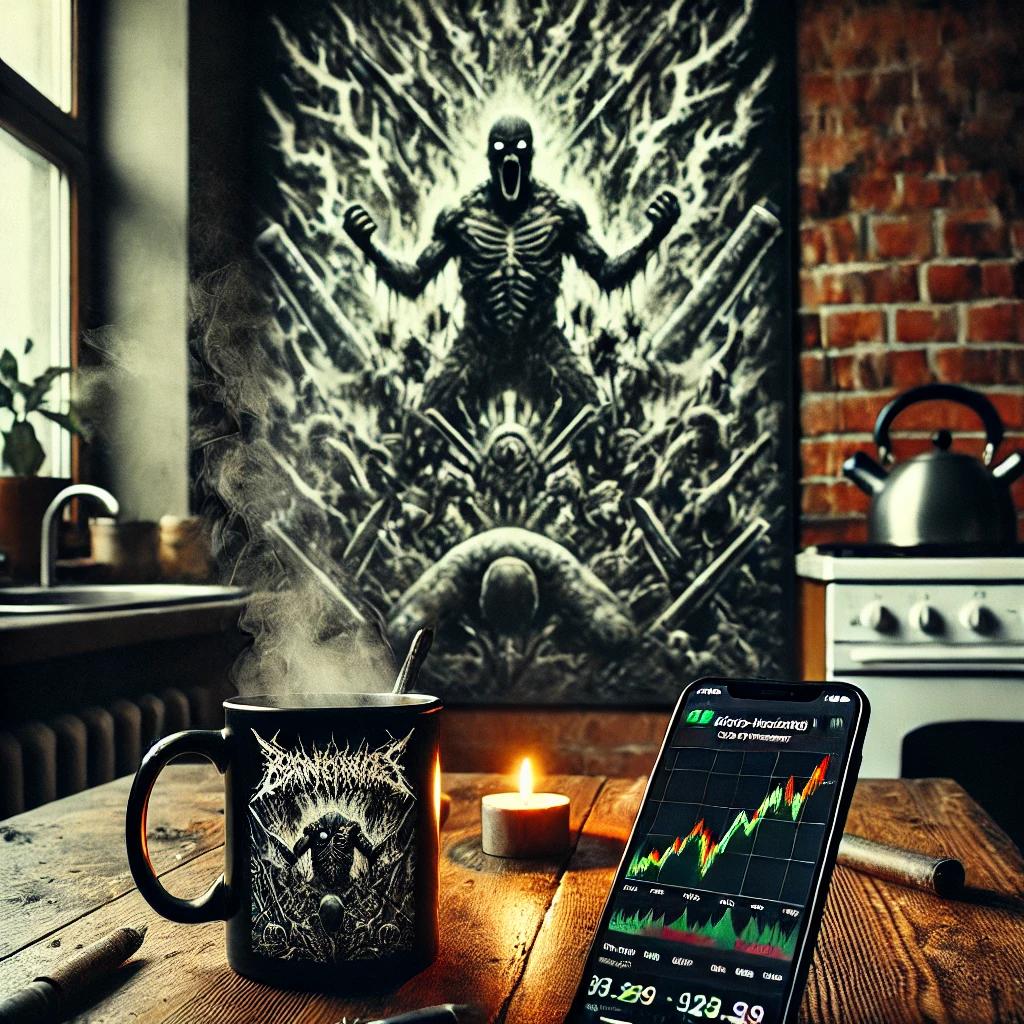
    A modern trading desk with chart-filled monitors and a unique mug, capturing the edgy spirit of coffee-fueled trading.

    Brew and Battle Stations


    Pushing Through Barriers
    Ultimately, the combination of hot coffee and a hungry mind is what turns pre-market scans into game-winning trades. It’s the intangible boost that says, “I’m awake, I’m ready, and I’m not backing down.” When the markets open and the volume surges, you’ve already established a groove—alert, prepared, and confident. You might still face losing streaks or misreads, but your caffeine ritual and rock-steady mindset can help you bounce back. Like an epic guitar solo right after a quiet interlude, coffee elevates your mental tempo, gearing you up for whatever the market decides to throw your way.


  • The Punk and Metal Roots of DIY Finance: Empowerment Through Knowledge

    The Punk and Metal Roots of DIY Finance: Empowerment Through Knowledge

    What do hardcore punk shows and personal finance have in common? More than you might think. Both celebrate DIY spirit, subverting mainstream norms, and calling BS on bloated institutions that profit off complacency. If you’ve ever gathered a ragtag group of friends to start a band in your garage, you already know what it feels like to forge a path with minimal resources and a maximum sense of rebellion. That same ethos can guide your approach to saving, investing, and managing money: no middlemen, no fluff, just raw, authentic control over your financial destiny.

    You’re not alone in feeling like large financial institutions don’t really have your best interests at heart. Much like you never trusted the slick, corporate label suits pushing out formulaic rock, you probably don’t trust banks that overcharge fees and lure you into subpar investments. If the raw power of a distortion pedal and a few power chords can start a cultural revolution, why can’t you channel that same energy to master your own finances? Welcome to the world of DIY finance—where knowledge is power, and you’re the one calling the shots.

    A Brief History of DIY Culture

    Zines, Underground Gigs, and Financial Freedom

    Before the internet made everything instantly shareable, the punk and metal scenes thrived on zines—handmade, photocopied magazines distributed by fans. These gritty, no-budget publications delivered unfiltered news and band interviews to local communities who were hungry for realness. It was a total middle-finger to mainstream media channels. Similarly, DIY finance flips off the conventional wisdom that says you must rely on big brokerages, pricey advisors, or complicated mutual funds.

    A report from the Federal Reserve highlights how self-education and a willingness to explore alternatives can break cycles of debt and poor savings habits. Just like a zine gave you the raw scoop on your favorite band, independent financial resources and online communities offer you unfiltered advice and tools you can use right now—often for free.

    Tools for DIY Investing

    Apps, Platforms, and Community Forums

    You don’t need to beg a record label to distribute your music in 2025—nor do you need a “traditional” brokerage account that charges you an arm and a leg to buy a few stocks. From user-friendly stock trading apps to decentralized crypto exchanges, your smartphone can be your backstage pass to the financial world.

    • Robo-Advisors: Platforms like Betterment or Wealthfront use algorithms to manage your portfolio.
    • Commission-Free Brokers: Apps like Robinhood and Webull let you trade stocks and crypto with zero commissions.
    • Decentralized Finance (DeFi): If you’re feeling extra rebellious, DeFi platforms allow peer-to-peer lending, borrowing, and yield farming without a central authority.

    And guess what? You can rock your self-made finance scene while sipping from unique coffee mugs for her if you want a little flair that screams, “Yes, I’m forging my own path, and I’m doing it with style.” Because who says your coffee mug can’t show off your bold personality or your DIY approach?

    collage of DIY finance imagery, including guitars, stock charts, and crypto logos, in a punk zine style

    Forge your own future, one riff and one trade at a time.

    Embracing Risk, Avoiding Exploitation

    The Rebellious Spirit of Self-Defense

    Punk and metal communities have always been about self-defense: from defending the pit to shielding subcultures from corporate whitewashing. Why not apply the same concept to your finances? Most people who haven’t taken the time to learn about budgeting, investing, and credit get trampled by hidden fees or unscrupulous advisors.

    A study by the Consumer Financial Protection Bureau (CFPB) indicates that many financial pitfalls—such as spiraling credit card debt or unreasonably high interest rates—can be mitigated with basic know-how and discipline. In a sense, you’re learning how to block a random shove in the pit. No one’s going to watch your back if you won’t.

    If you’re starting to wonder if there’s more going on behind the scenes of our financial system, you’re not the only one. Why not keep a conspiracy theorist coffee mug at your desk as a reminder to question everything? After all, metal and punk fans have a long history of bucking authority. Might as well carry that attitude into your 401(k) or crypto wallets, too.

    A Rallying Cry for the DIY Investor

    Knowledge = Empowerment

    • Budgeting: Like practicing guitar scales, budgeting is the fundamental skill that underpins everything else. If you can’t handle your day-to-day money, no fancy stock pick will save you.
    • Investing: Once you have extra cash, put it to work. Whether it’s a well-balanced stock portfolio, a few well-researched crypto bets, or some real estate crowdfunding, the point is to direct your cashflow into assets that can grow.
    • Continuous Learning: Punk and metal scenes thrive on discovering new bands, new sounds, new ways of self-expression. Apply that thirst for discovery to your finances. New platforms and opportunities pop up every day—keep exploring them.

    At its heart, DIY finance isn’t just about money—it’s about self-determination. You don’t let corporate radio stations decide what music you should listen to; why let a corporate advisor decide how to invest your hard-earned cash? The tools are out there; all it takes is the same rebellious spark that propelled your favorite band from garage nobodies to genre-defining legends.

    From gritty zines to unstoppable underground movements, punk and metal have always advocated for taking control when the mainstream just won’t cut it. The same is true for your finances: the less you rely on stuffy institutions, the more you learn, experiment, and define your own path, the more empowered you become. It’s not about being a lone wolf with no guidance; it’s about choosing resources and communities that respect your autonomy rather than draining it.

    Next time you’re blasting a relentless riff, picture applying that energy to evaluating your portfolio or tinkering with a new investment platform. The rebellious spirit that shaped your musical tastes can transform how you see money. Remember, every movement started with just a few idealists who refused to accept “the way things are.” You can carry that flame—channel the raw power of punk and metal into your wallet, your retirement account, or your everyday spending decisions. Because if there’s one thing these subcultures taught us, it’s that real change starts from the bottom, with people who dare to do it themselves.

  • Headbanging Through the Bear Market: Surviving Stock Slumps

    Headbanging Through the Bear Market: Surviving Stock Slumps

    The market is down, your stocks look like they’ve been drop-kicked into the underworld, and every headline screams doom. Sound familiar? It’s called a bear market, and if you’re not ready to fight for your sanity, it can chew you up and spit you out. But here’s the thing: if you’re a devoted metalhead, you’re already trained to endure chaos—whether it’s in the middle of a mosh pit or blasting brutal riffs in your headphones. Why not take the same no-nonsense attitude to your portfolio?

    Just like a surprise guitar solo can turn a song on its head, the market can flip overnight, leaving even seasoned investors shell-shocked. But as every metal fan knows, sometimes you’ve got to keep headbanging through the breakdown. So sharpen your elbows and crank up the amps, because we’re about to explore how to not only endure a bear market—but to come out of it stronger.

    The Bear Market Blues
    What It Is and Why It Happens

    A bear market occurs when stock prices tumble by 20% or more from recent highs, reflecting widespread pessimism. According to Investopedia, bear markets can be triggered by economic slowdowns, geopolitical upheaval, or even a sudden loss of investor confidence—just like how the mood at a metal show can shift if the crowd picks up on negative energy.

    Does that mean we should all throw in the towel? Hardly. Just like you wouldn’t quit on your favorite band the minute they release one weak album, you don’t bail on the market the moment things get choppy. Bear markets are an inevitable part of the economic cycle, and surviving them is how the real legends are born.

    Coping Mechanisms
    Budget, Diversify, and Headbang

    1. Reassess Your Portfolio
      • Bear markets can expose weaknesses—both in your holdings and your risk tolerance. Now’s the time to see which stocks (or funds) are truly worth holding and which are dragging you down. A little pruning can free up resources to invest in opportunities that may arise when prices are low.
    2. Build a Safety Net
      • If possible, maintain some cash reserves or stable assets so you’re not forced to sell at rock-bottom prices. It’s like wearing sturdy boots in the pit: you’ll thank yourself when the crowd starts pushing back.
    3. Stay Educated
      • Knowledge is your best armor. Dive into articles, talk to financial pros, and read up on market trends. The U.S. Securities and Exchange Commission (SEC) offers investor education resources that can help you spot scams and navigate turbulent times. The more you know, the less fear has a hold on you.

    And if the gloom starts getting to you, sometimes you need to send a clear message to the world—like sipping from a fuck off coffee mug that embodies your rebellious attitude. After all, if you’re wrestling with a bear market, you don’t have time for sugarcoated nonsense.

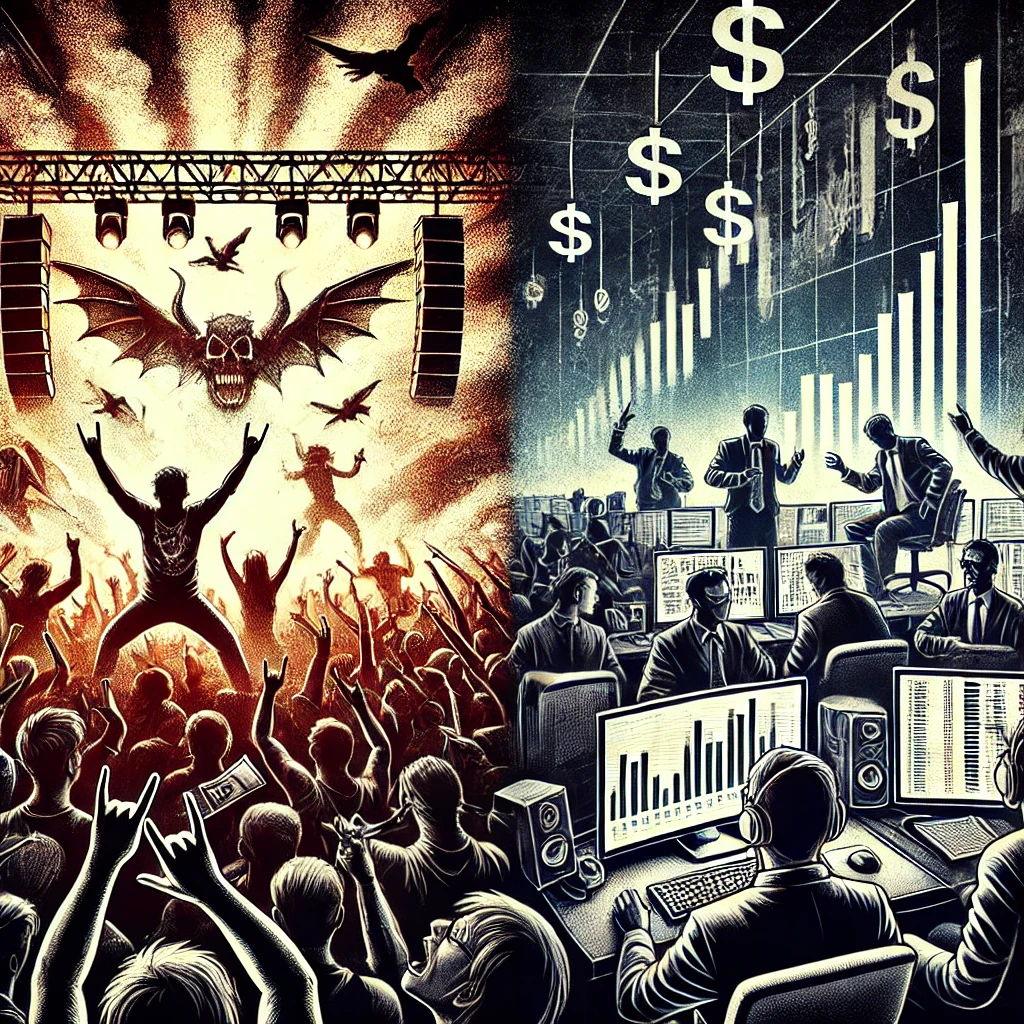
    crowded mosh pit set against a falling stock chart, symbolizing surviving a bear market with a metal mindset

    When the market tanks, crank up the volume—bear markets call for brutal riffs.

    Positioning for the Rebound
    Buying the Dip (Or Holding Until It’s Over)

    Most legendary metal records were forged in tough times—bands channeling real pain into epic anthems. Similarly, bear markets can be prime hunting grounds for savvy investors who spot undervalued stocks. Warren Buffett famously suggests being “fearful when others are greedy, and greedy when others are fearful,” implying that solid bargains emerge when widespread panic pushes prices too low.

    1. Focus on Quality
      • Even the strongest companies can tank in a bear market, but they’re also the most likely to rebound when sentiment flips. Keep an eye on essential industries like energy, healthcare, or innovative tech—think of them as your core rhythm guitar, anchoring your portfolio.
    2. Use Dollar-Cost Averaging
      • If you believe in an asset long term, spread your purchases over time instead of trying to guess the exact bottom. This approach balances out short-term price swings. No one nails the perfect entry point every time, and it’s better to join the song at a decent spot than to miss it entirely.
    3. Diversify with Alternatives
      • Cryptocurrencies or gold can sometimes buck the trend—or at least move to a different drumbeat—during stock slumps. Just be sure you understand the risks before diving in. According to Bloomberg, crypto markets can be even more volatile than equities, so approach them with caution.

    If you do dabble in Bitcoin during the chaos, you might as well stash it in style. A bitcoin-themed coffee mug can serve as a cheeky reminder that while the stock market might be tanking, there’s a whole other realm of digital possibility out there.

    A bear market might knock the wind out of your portfolio, but remember: metalheads don’t shy away from adversity—they crank the volume and plow straight through it. By budgeting wisely, diversifying, and maybe tapping into alternative assets, you can navigate the gloom and come out with some serious investing scars—AKA experience.

    You’ll come away with more than just bruises; you’ll have a refined strategy, a tougher psyche, and maybe even a new perspective on what “value” really means. So the next time red numbers flood your screen, think of it as the breakdown in your favorite song—brutal, intense, but ultimately setting the stage for a crushing comeback.

    In other words, keep your boots laced, your coffee scorching, and your riffs savage. Because a bear market can’t kill your spirit if you’re headbanging right through it.

  • From Coffee Beans to Capital Gains: The Value of Nurturing Potential

    From Coffee Beans to Capital Gains: The Value of Nurturing Potential

    Picture the journey of a tiny coffee bean. Planted in nutrient-rich soil, it’s watered, shielded from harsh elements, and carefully tended until it transforms into a flavorful roast. Now think about a fledgling tech startup or an emerging crypto project. They need time, resources, and a bit of faith to blossom into industry powerhouses or even market disruptors. In both cases, the real magic happens when we nurture potential—and that goes for everything from your morning cup of joe to the next big asset in your portfolio.

    Life’s too short for mediocre brews or stagnant investments. If you’re curious how the wisdom of growing quality beans can inform a dynamic investing strategy, buckle up. We’re about to dig into parallels between coffee cultivation and capital gains, and why patience might just be your best ally in both arenas.

    Cultivation and Care

    Beans or Assets: The Principles Are the Same
    Whether you’re raising coffee plants or identifying promising investments, you’ve got to start with high-quality seeds. A coffee farmer looks for beans with strong genetic traits; an investor scouts companies or cryptos with sound fundamentals and a compelling growth story. According to an FAO (Food and Agriculture Organization) report on global coffee production, the health of the soil and the climate around the bean can significantly impact yield and flavor. Substitute “soil and climate” with “market conditions and regulatory environment,” and you have a pretty solid parallel for what shapes a company’s potential.

    Time and Patience
    Just as coffee cherries don’t ripen overnight, the companies you invest in won’t skyrocket immediately. If you plant a seed and expect it to become a towering tree by tomorrow, you’re setting yourself up for disappointment. The same goes for buying into a stock or crypto. Sure, there are hype-fueled moonshots that blow up in weeks, but that’s more the exception than the rule. According to a study from Morningstar, long-term holding often outperforms short-term trading, underscoring the payoff of letting growth compound over time.

    It’s like sipping your morning brew from cute coffee mugs: you wouldn’t burn your tongue by chugging it instantly. Instead, you enjoy the warmth, aroma, and taste at a steady pace. If you’re willing to be patient, you’ll savor the entire experience—and give your investments room to breathe.

    Roasting and Timing

    Hitting the Sweet Spot
    In coffee roasting, finding that sweet spot is critical. Roast too long, and the beans turn bitter. Pull them out too soon, and they taste underdeveloped. The same principle applies to deciding when to buy, hold, or sell an investment. Timing isn’t about being psychic; it’s about recognizing certain signals—like the bean’s color, crack, or aroma in coffee, or a company’s earnings, market sentiment, and product launches in the stock world.

    Over-roasted beans and over-held stocks can both leave a sour taste. That’s why your research needs to be on point. Know the bean variety (or company fundamentals), monitor the roast temperature (market conditions), and decide when you’ve got something that’s just right for your palate (profit target or exit strategy).

    yellow coffee mugs near fresh coffee beans and a rising stock chart, symbolizing growth and nurturing potential

    Foster the bean, foster the balance sheet—patience grows profits.

    Ongoing Maintenance

    Tending the Crop, Tending the Portfolio
    Coffee farms don’t stop caring for the plants once they sprout. They prune, fertilize, and shield the beans from pests and harsh weather. Likewise, a portfolio isn’t a “set it and forget it” operation if you’re serious about gains. Periodically check in, rebalance, and prune out underperformers. And, as any seasoned investor knows, “weather” can take many forms—recessions, regulatory crackdowns, or unexpected tech breakthroughs that shake up entire sectors.

    During these check-ins, it helps to keep a positive outlook—especially if your positions have dipped. Lift your spirits with yellow coffee mugs that bring a burst of optimism to your routine. After all, nurturing potential is as much about mindset as it is about technical skill.

    Research, Adapt, Repeat
    Don’t assume today’s conditions will stay the same tomorrow. A climate shift can ruin your coffee crop just as a major competitor can tank your investment. Stay curious, keep learning, and be willing to tweak your approach. Sometimes, that means adjusting your brewing method for a new roast; other times, it means pivoting out of a sector when fundamentals change dramatically.

    From coffee beans to capital gains, the journey is about nurturing potential. Each step—selection, cultivation, timing, and ongoing care—mirrors the path of shepherding a tiny seed into something robust and valuable. If you’re patient, committed, and willing to adapt, you’ll often find that both your morning brew and your investment returns are richer than you could have imagined.

    In an age of instant gratification, embracing the slow-and-steady approach can feel revolutionary. But let’s face it: some of the best things in life take time to develop, whether it’s the depth of flavor in a freshly roasted bean or the incremental growth of a company poised for greatness. So next time you savor your coffee, remember that you’re also perfecting the art of patience. And in the world of investing, a little patience just might lead to your strongest returns yet.

  • The Mosh Pit vs. the Stock Pit: Crowds, Chaos, and Crowd Psychology in Markets

    The Mosh Pit vs. the Stock Pit: Crowds, Chaos, and Crowd Psychology in Markets

    The opening bell rings at 9:30 a.m. Traders jostle for position, eyes glued to flashing numbers, hearts pounding with excitement (or panic). If you’ve ever stood at the edge of a metal gig when the guitars drop, you already know this feeling. A mosh pit can be a lesson in raw energy, collective emotion, and the exhilarating push-and-pull of the crowd. But guess what? The stock market isn’t all that different—it’s another “pit” where group behavior can mean the difference between epic gains and a hard slam to the wallet. Strap in, because we’re about to compare high-stakes finance with the frenzied chaos of live metal.

    Chaos, Meet Psychology

    When people gather, they get swept up in a shared energy. In a mosh pit, that can mean elbows flying and adrenaline surges as the music blasts at max volume. On the trading floor, it can mean frantic buying and selling the moment a stock’s ticker lights up green—or plummets red. According to an American Psychological Association overview of crowd behavior, humans often take cues from those around them, whether they’re headbanging or hitting the “buy” button. This herd mentality can spark a chain reaction in both worlds, showing just how powerful collective dynamics can be.

    But let’s get one thing straight: chaos doesn’t have to be your enemy. In the pit, you learn to hold your ground or ride the wave; in the market, you can either ride the momentum or time your exit before the wave crashes. Understanding what fuels that collective rush can be the key to thriving instead of taking a nasty tumble.

    Mosh Pit or Market Open?

    Beyond the high-octane thrills, these two arenas share a few distinct similarities:

    1. Frenzied Starts
      • In a metal show, the moment the band strikes its first chord, the pit ignites.
      • On the trading floor, the second the bell tolls, buy/sell orders flood in.
      • The point? Stay alert. One second of hesitation could knock you down—or leave you behind in the dust of missed trades.
    2. Euphoric Highs and Sudden Turns
      • In the pit, the vibe can shift from playful pushing to an all-out frenzy if a circle pit forms.
      • In the market, sentiment can pivot on a single headline. After all, a bit of unexpected news has been known to tip entire sectors into free fall.
      • Lesson: Keep your head on a swivel and be ready to adapt.
    3. Tapping into Shared Energy
      • Metal fans feed off each other’s intensity. Finance folks do the same, only with stock charts instead of guitar riffs.
      • In both cases, momentum can become a self-fulfilling prophecy—positive or negative.

    It’s about harnessing the energy rather than letting it knock you off your feet. If you want to channel that same unhinged vibe next time you analyze the market, you could psych yourself up with a serious dose of coffee in a novelty coffee mug. It’s one way to remind yourself that chaos can be fun—and occasionally profitable—if you learn the rhythm.

    Mastering the Pit and the Pitfalls

    So how do you avoid getting metaphorically stomped? Preparation. At a show, you might wear sturdy boots or station yourself at the pit’s edge. In the stock market, you prep by reading daily news, setting stop-loss orders, or diversifying your positions. One misstep in either realm can leave you dizzy or out cold, so gear up.

    The Wall Street Journal has noted that high market volatility frequently boils down to collective emotions—fear, greed, or euphoria. When everyone piles in or out at the same time, that’s the group dynamic in action. By stepping back and assessing the situation calmly (or as calmly as you can when your favorite band hits a breakdown), you reduce the risk of making impulsive decisions. Know your limits, gauge the crowd, and be ready to pivot.

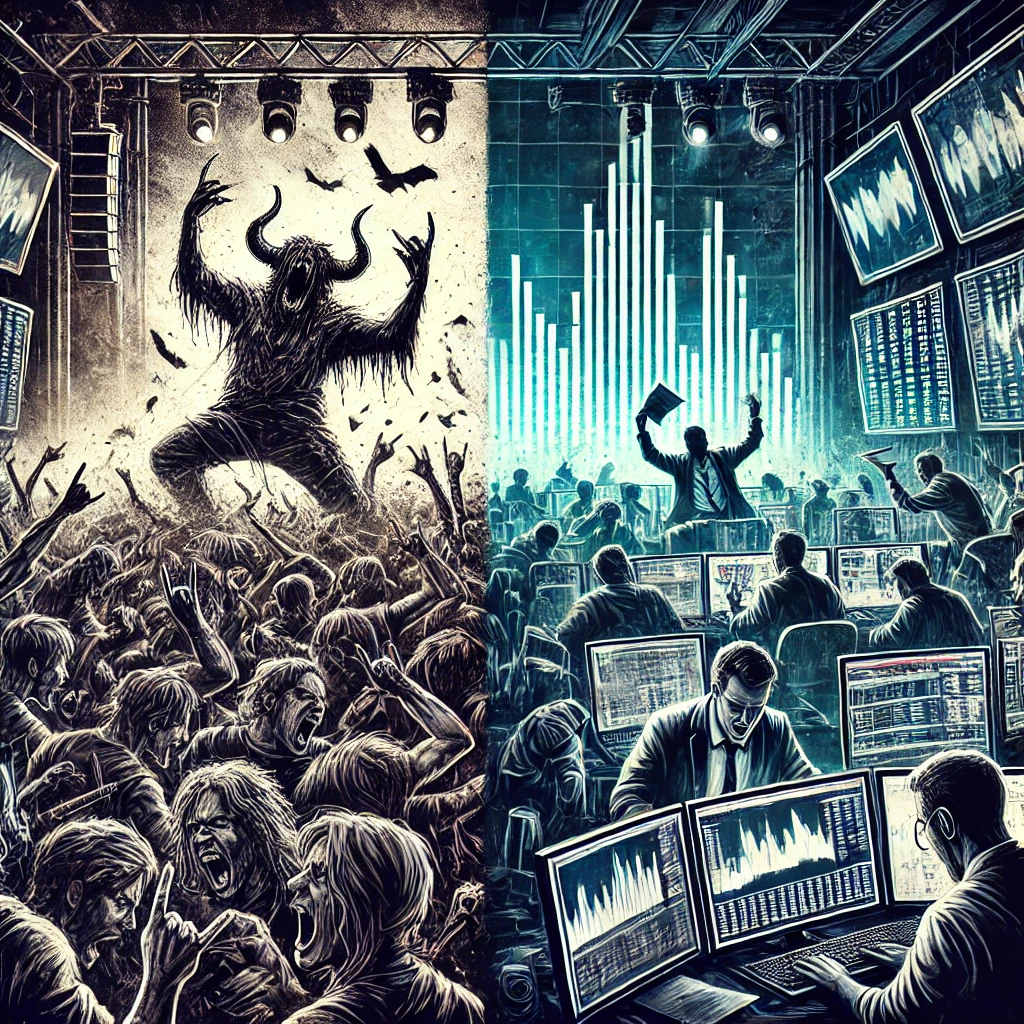
    mosh pit on one side, crowded trading floor on the other, showing parallel chaos
    Two worlds, one shared rush.

    Surviving and Thriving

    Whether you’re swinging your arms in a surge of guitar distortion or firing off trades when a stock gap opens, the same principles apply:

    1. Pick Your Spot
      • In a real pit, you might stand near the edge if you’re less experienced. In the market, you could try conservative plays or watch for clear entry points.
    2. Watch the Signals
      • In a show, the band’s tempo or crowd’s mood can signal a shift. On a trading floor, a notable spike in volume or an extreme jump in price is your warning to move carefully.
    3. Know When to Jump Out
      • Sometimes, the energy is just too volatile. If the market is spiking uncontrollably—like a brutal wall of death—you might want to sidestep until the crowd (or price) settles.
    4. Stay True to Your Style
      • Some people love the pit’s mayhem; others prefer a calmer vantage point. Similarly, some investors chase volatile penny stocks, while others invest in safer, long-term holdings.

    And if you’re feeling extra bold, arm yourself with a manly coffee mug that suits your fearless approach. Because let’s be honest: if you’re going to dive into the chaos, you might as well caffeinate with an attitude.

    From circle pits to market fits, crowd psychology remains a driving force behind our most intense experiences. We feed off each other’s adrenaline, and whether that results in euphoria or a blindsided takedown depends on how prepared we are. Recognizing the parallels between a raucous concert floor and a frenzied trading session is more than just a fun metaphor—it’s a reminder that we’re all wired to sync up with the energy around us.

    So next time you see a stock surging or a crowd swirling, remember the pit rules: stay aware, ride the energy, and know when to step aside. Keep your eyes open, your stance solid, and your rebellious spirit intact. Who knew the secrets to mastering the markets might be found amid the roar of guitars and the crush of bodies?

  • Grindcore & Grind Savings: Making Sense of Micro-Investing Apps Over Your Morning Brew

    Grindcore & Grind Savings: Making Sense of Micro-Investing Apps Over Your Morning Brew

    Raw Energy Meets Small Steps

    Grindcore music isn’t about half-measures—just like metal’s most ferocious subgenre, it’s fast, loud, and relentless. Meanwhile, micro-investing is all about little steps that can build into something massive over time. At first glance, these two worlds couldn’t be more different. Yet if you’re the type to blast unrelenting riffs first thing in the morning, you might find surprising harmony in sipping coffee and automating your spare change into investments. According to NerdWallet, small amounts can compound into significant gains if you stay consistent—much like how tiny bursts of grindcore brutality can form an entire blistering set.

    Morning Brew and Micro-Investing

    Traders often fixate on large-cap stocks and day trading, but micro-investing apps let anyone dip into the market at their own pace. You link a debit card, and every time you buy groceries or snag coffee beans, the app rounds up the purchase and invests the difference. It’s effortless—like a background drum track hammering away while you sip your morning brew. If you want to add a bit more of that rebellious flair to your setup, consider raising a coffee mugs for traders that reminds you to keep grinding (and HODLing) for the long haul. Because even a handful of cents here and there can stack up when you’re consistent.

    Why Grindcore? Why Micro-Investing?

    Grindcore thrives on a do-it-yourself ethos. Bands record in makeshift studios, distribute music through underground channels, and book shows in basements or tiny clubs. Micro-investing apps likewise dismantle barriers to entry. You don’t need thousands of dollars to start—just a smartphone and a willingness to funnel spare change into an ETF or stock slices. Both worlds reject the gatekeeping that says you have to be “rich” or “polished” to participate. The Wall Street Journal once reported on how micro-investing democratizes the market, pulling in folks who might otherwise be sidelined. Just as grindcore invites fans to create their own intense, no-frills music, micro-investing invites everyday people to build wealth incrementally.

    Steps to Get Grinding with Micro-Investing

    Pick an App: Choose a reputable micro-investing platform. Research its fees, user interface, and whether it aligns with your investment preferences.

    Link Your Card: Allow round-ups or periodic transfers. Even one dollar a day can evolve into a considerable stash over time.

    Set and Forget: Like the relentless beat of a grindcore track, consistency is key. You don’t need to tweak the settings daily—just trust the process and occasionally check your balances.

    Channel the Grind: Throw on your favorite blast beat track while you finalize your settings—let the unrelenting drums remind you that little increments, repeated often, become unstoppable momentum.

    Sustaining the Groove

    Maintaining your enthusiasm for micro-investing can be tricky if you’re not seeing big returns right away. Yet the same can be said for discovering a new grindcore band—you might not love it instantly, but over time, the intensity clicks, and you’re hooked. If motivation slips, spice up your coffee routine. Sip from a mom coffee mug just to keep things ironically fun and remind yourself that even a metalhead can have that everyday, caring side. Balance the comedic mug choice with a fierce approach to saving, because the more you treat investing like a daily habit, the more natural it becomes.

    Surviving the Daily Grind (and the Grindcore)

    Every band has off days; every investor sees red in their portfolio at some point. The micro-investing mindset helps you push through. When your spare change invests automatically, you aren’t wrecking your budget or panicking over daily fluctuations. It’s like background noise that eventually builds a massive wall of sound—except this wall of sound can translate to a growing balance over months and years. CNET emphasizes how automating finances helps people save without overthinking. And if the markets tank, you can treat it like a brutal breakdown in a grindcore song—part of the experience, not the end of the world.

    Why It All Works

    Grindcore and micro-investing might sound like a bizarre combo, but they share core principles: efficiency, repetition, and an unyielding spirit. Grindcore condenses songs into short bursts of aggression; micro-investing condenses wealth-building into manageable daily increments. Both rely on consistent, relentless motion. If you can embrace such intensity in your playlist, you can embrace a slow-and-steady investment strategy without losing that rebellious spark. Each round-up deposit is like a blast beat—tiny, fast, and cumulative. Over time, those blasts form a full track, and those deposits form a respectable portfolio.

  • Fintech Revolution: Death Metal Mugs’ Guide to the Stock Market’s Makeover

    Yo, metalheads! Crypto Bro Charlie here, ready to drop some truth bombs on the Fintech revolution. This ain’t your grandpappy’s stock market, bruv. We’re talking algorithmic trading, AI-powered analysis, and fractional shares—it’s a total game changer, and it’s all happening right now.

    The Algorithmic Avalanche

    Algorithmic trading, or algo-trading, is basically robots making trades at lightning speed. It’s automating the market, finding inefficiencies, and executing trades faster than any human could. This isn’t some sci-fi fantasy; it’s the reality of modern markets. These algorithms are analyzing vast amounts of data to identify trends and opportunities, adjusting to market volatility in a way that’s impossible for humans. This high-frequency trading (HFT) is transforming market liquidity and speed; it’s wild.

    Think of it like this: Imagine a death metal riff played at 1000 bpm. That’s how fast these algorithms are operating. They’re constantly scanning for opportunities, executing trades in milliseconds, leaving human traders in the dust. While this speed has benefits, it also presents risks. But hey, high risk, high reward, right?

    AI: Your New Financial Guru

    Artificial intelligence is another major player in the Fintech revolution. AI-powered platforms are analyzing tons of data—financial news, social media sentiment, even weather patterns—to predict market movements and identify promising investments. It’s the ultimate death metal headbanger for data analysis. This is next level stuff; it’s not just crunching numbers; it’s learning, adapting, and evolving. This has increased the accessibility to advanced financial instruments.

    Some of these AI systems can even personalize investment strategies, tailoring them to an individual’s risk tolerance and financial goals. It’s like having a personal financial advisor that never sleeps and never gets bored. Now, that’s a moonshot I can get behind. However, it’s important to note that even the best AI is only as good as the data it’s trained on, so be sure to do your own research.

    Fractional Shares: The Democratization of Investing

    Remember when you needed thousands of dollars to buy a single share of a major company? Not anymore. Thanks to fractional shares, even those with limited capital can invest in blue-chip companies and diversify their portfolios. This opens doors for a broader spectrum of investors and allows for more balanced market participation. This is HUGE, bruv. It’s like finally getting a chance to grab a piece of that sweet, sweet Lambo action, even if you’re only chipping in a few bucks. It’s a step towards a more inclusive investment landscape.

    This level of accessibility might change market dynamics altogether. It could lead to greater market volatility and more diversified participation. It certainly expands opportunities, which is what I’m all about. This is a level playing field for the masses. The stock market is no longer a closed club just for the wealthy elite.

    Robo-Advisors: Your Personalized Investment Bot

    Robo-advisors are automated investment platforms that provide personalized portfolio management based on your risk tolerance and financial goals. They’re like having a super-efficient, tireless financial advisor at your fingertips, 24/7. These platforms often use algorithms and AI to manage your investments, making it easier and more accessible than ever to participate in the market. But remember, this tech is as good as the data it’s using. So you still gotta be on your toes.

    With robo-advisors, you’re getting customized investment strategies without the hefty fees of a traditional financial advisor. It’s a great option for beginners and busy investors who want to automate their portfolio management, but still want some level of personalization. This tech is helping to make finance more democratic and available to everyone.

    The Future is Now: Embrace the Chaos!

    The Fintech revolution is changing the stock market faster than a Slayer guitar solo. It’s creating massive opportunities, but also challenges. The increased use of AI and algorithms presents both risks and rewards. The increased automation means the market is reacting faster, and it’s harder to predict the next move. It’s a whole new level of chaos! And you know what I love? Chaos!

    As a death metal fan, I live for the intensity, the unpredictability, the pure, unadulterated energy. The stock market, with all its volatility and algorithmic trading, mirrors that same raw intensity. You can’t just follow the herd, bruv. You gotta find your own riffs, your own unique strategy. Embrace the challenge. Do your research. And never stop searching for that next moonshot. And while you’re planning your next trade, why not grab a crazy coffee mug to fuel your next mission?

    This is a brave new world, and I, for one, am stoked to see what happens next. To fully understand the impact of these technologies, I recommend reading this insightful report from the Federal Reserve and checking out this analysis from the Investopedia website. YOLO!

  • Brewing Up a Better Portfolio: Corporate Governance and Ethical Investing

    Gentlemen, let’s talk about something near and dear to my heart – besides perfectly roasted Ethiopian Yirgacheffe, of course: protecting your investments. It’s a topic as nuanced as a single-origin espresso blend, requiring both meticulous attention to detail and a dash of healthy skepticism. This isn’t about chasing the next hot crypto token (though I confess, I’ve been tempted to dip my toes into that volatile pool – mostly out of morbid curiosity). No, this is about long-term strategy, the kind I honed over decades of working the phones and trading floors.

    Understanding the Landscape: Corporate Governance and You

    Corporate governance, in its simplest form, is the system of rules, practices, and processes by which a company is directed and controlled. It’s the framework that shapes how a company operates, interacts with its stakeholders (including us investors!), and makes decisions. Now, I know what some of you are thinking: “Gil, this sounds about as thrilling as watching paint dry.” But trust me, the implications are far-reaching. A company with robust governance mechanisms is far more likely to act responsibly, manage risks effectively, and ultimately deliver better returns over the long haul. Think of it as brewing the perfect cup: the right beans, the right grind, the right water – all vital components for a superior outcome.

    Ethical practices are intrinsically linked to good governance. When a company operates ethically, it builds trust with investors, customers, and employees. This trust translates into a stronger brand reputation, improved employee morale, and increased customer loyalty – all factors that can positively impact the bottom line. It’s the difference between a cheap, mass-produced coffee and a carefully crafted artisanal blend.

    Assessing Ethical Standards: Beyond the Hype

    Now, here’s where the detective work begins. Assessing a company’s ethical standards isn’t as simple as reading their mission statement (though, a blatant disregard for ethical behavior usually manifests itself there). You need to look beyond the marketing fluff and delve deeper. Start by examining their sustainability reports, looking for evidence of responsible sourcing, environmental stewardship, and fair labor practices. Do they engage in meaningful community investment? Do they have a transparent supply chain? These are critical indicators of a company’s ethical commitment.

    Another crucial aspect is evaluating their approach to risk management. Does the company proactively identify and mitigate potential risks? Do they have robust internal controls in place to prevent fraud and corruption? A company’s commitment to risk management reflects its overall maturity and its dedication to long-term sustainability. Consider it akin to my rigorous coffee-making process – I wouldn’t dream of skipping any steps in this sacred ritual.

    Consider also checking out independent ratings agencies that assess corporate social responsibility (CSR) performance. These agencies offer valuable insights, though it’s important to consider their methodologies and potential biases. It’s like comparing coffee reviews from different publications – some are more discerning than others. Always conduct your own due diligence. One such helpful source is the Investopedia guide to Corporate Social Responsibility which provides an overview of the concept and importance of CSR.

    The Impact on Investment Returns: More Than Just Warm Fuzzies

    Many believe that ethical investing is merely a feel-good endeavor, sacrificing returns for moral principles. However, research suggests a strong correlation between ethical practices and long-term investment success. Companies with strong governance and ethical reputations tend to outperform their less responsible counterparts over time. This isn’t just a matter of ‘doing good’; it’s about mitigating risks and building resilience. An ethically sound company is less likely to face reputational damage, regulatory fines, or costly lawsuits – all of which can significantly impact shareholder value. It’s like buying a well-built, durable machine rather than a cheaply made one that will break down quickly.

    Studies also show that investors are increasingly prioritizing Environmental, Social, and Governance (ESG) factors in their investment decisions. This growing demand for ESG-aligned investments is driving a shift in the market, creating opportunities for companies that prioritize ethical practices. The trend is definitely moving in a positive direction, albeit slowly.

    For a deeper dive into the academic research supporting this connection, I highly recommend exploring resources like the Wall Street Journal’s articles on ESG investing which discusses recent trends and market impact.

    My Final Sip: A Blend of Prudence and Principle

    As a retired stockbroker and self-proclaimed coffee aficionado, I appreciate the importance of both meticulous planning and mindful consumption. Investing ethically isn’t just about maximizing returns; it’s about aligning your values with your investments, ensuring that your money contributes to a more sustainable and equitable future. Besides, wouldn’t you rather sip your perfectly brewed coffee knowing your investments reflect your principles? And while we’re on the topic of perfect beverages, if you need a mug worthy of your discerning taste, you might appreciate a nice coffee mug.

    So, my friends, raise a mug (preferably one from DMM) to ethical investing. It’s a long-term game, but the rewards – both financial and personal – are well worth the effort.

  • Navigating Risk: A Practical Guide to Investment Risk Management

    Hey crew, Stock-Trader Steve here. Let’s talk about something crucial for anyone dipping their toes into the market: risk management. It’s not about avoiding risk altogether—that’s impossible. It’s about understanding it, quantifying it, and mitigating it like a seasoned metalhead dodging a rogue stage diver. (Speaking of which, remember that time at the Mayhem show? Good times.)

    Understanding Your Risk Tolerance

    Before we dive into strategies, let’s nail down the basics. Your risk tolerance is personal. It’s not a one-size-fits-all thing. Are you the type who’s comfortable with aggressive growth, even if it means some wild swings? Or do you prefer a steady, predictable climb, even if it means slower gains? Knowing your tolerance guides your entire investment strategy. There’s no right or wrong; it’s about honestly assessing your own comfort level. A good starting point is understanding your investment goals, time horizon and financial capabilities.

    Think about it: Are you investing for retirement decades away, or for a down payment on a new guitar amp in a year? That timeframe drastically alters your risk profile. Long-term investors can handle more volatility than short-term investors. A longer time horizon allows more flexibility to recover from market downturns.

    Diversification: Don’t Put All Your Eggs in One Basket

    This isn’t just a cliché; it’s a fundamental principle. Diversification spreads your investments across different asset classes (stocks, bonds, real estate, etc.) and sectors. Think of it like building a killer playlist—you wouldn’t just fill it with death metal, would you? (Okay, maybe you would, but you get the point.) A balanced portfolio helps cushion the blow if one investment takes a dive.

    A helpful rule of thumb is to consider your age. Many financial advisors recommend investing a portion of your portfolio in a percentage equal to your age in bonds and the remaining in stocks. This strategy reduces risk while still allowing for potential growth.

    For example, if you’re 30, 30% of your portfolio could be in bonds and the remaining 70% in stocks.

    Asset Allocation: Finding Your Perfect Blend

    Asset allocation is how you distribute your investments across those different asset classes. It’s directly tied to your risk tolerance. A conservative investor might allocate a larger portion of their portfolio to bonds and less to stocks, while a more aggressive investor might do the opposite. It’s about finding the balance that feels right for you and aligns with your financial goals. You need to find the right balance between risk and reward.

    It’s also important to regularly review and adjust your asset allocation to reflect changes in your financial situation and market conditions. As markets change, so should your portfolio in response. Think of it as regularly tuning your guitar – keeping it in optimal playing condition.

    Risk Assessment: Know the Odds

    Understanding the risks involved in any investment is absolutely critical. This goes beyond just looking at the price. Consider things like a company’s financial health, market trends, and even geopolitical factors. There’s no magic bullet, but doing your homework dramatically reduces your chances of getting burned. Remember, even the best-laid plans can go sideways, but solid research dramatically increases your odds of success.

    Remember that financial markets involve a degree of uncertainty. Before making investment decisions, perform thorough research, seek professional advice and consider consulting financial statements.

    One excellent resource to get up to speed on risk assessment techniques is the Investopedia article on risk assessment, which covers various methods and techniques used by professionals.

    Riding the Waves: Practical Strategies

    No matter how well you plan, there will be bumps in the road. That’s just the nature of the market. One of the most effective tools for mitigating risk is dollar-cost averaging, a strategy that involves investing a fixed amount of money at regular intervals regardless of the market’s price. This reduces the risk of investing a large sum of money at an unfavorable time, helping to average out your purchase price over time.

    Another strategy is to diversify your investment across different geographies. Global diversification helps to reduce risk by not relying on any one economy’s performance, meaning when one economy struggles, others might be doing better, creating a cushion for your investment.

    To further mitigate risk, you could also consider investing in index funds or Exchange-Traded Funds (ETFs). These offer broad market exposure, reducing the risk associated with individual stock picking. These instruments track a specific index, such as the S&P 500, so they offer diversified exposure to a wide range of stocks.

    And remember, diversification doesn’t just apply to stocks. It’s about spreading your investments across various asset classes like bonds, real estate, and even a little Bitcoin (because, let’s be honest, crypto adds a certain rebellious flair to any portfolio. Just remember to keep it a reasonable portion – don’t go full YOLO on that front). For cold mornings, nothing beats a rich, dark cup of coffee in my irish coffee mug before I start my day.

    The Bottom Line

    Risk management isn’t about playing it safe; it’s about playing smart. It’s about understanding your tolerance, diversifying your investments, and having a plan for when things get bumpy. So, do your homework, stay informed, and remember, even a seasoned trader like myself has had a few bumps along the road. But that’s part of the thrill – the challenge of navigating the market. The thing is, you’re not in it alone. Stay tuned and let’s tackle this together.

    And hey, if you need a hand with anything, you know where to find me. This isn’t just about money; it’s about building a community. We’re in this together.

    For more in-depth information on risk tolerance questionnaires, you can check out the Fidelity Risk Tolerance Questionnaire.

  • The Psychology of Investing: Why Your Gut Feels Like a Bear Market

    Gentlemen (and ladies, if any have stumbled upon this unexpectedly refined corner of the internet), let’s talk about something near and dear to my meticulously organized heart: the psychology of investing. Because while I may triple-filter my water and hand-grind my beans to a micron-level precision, the markets are a far less predictable beast.

    The Emotional Rollercoaster: Riding the Waves of Fear and Greed

    We’ve all been there. The gut-wrenching drop, the exhilarating surge, the sleepless nights fueled by questionable investment choices. Behavioral finance teaches us that our emotions aren’t mere spectators in this game; they’re the star players, often calling the shots with reckless abandon. Fear and greed, those ancient market drivers, are the conductors of our financial orchestra – playing a chaotic symphony of losses and gains.

    The research is quite clear: cognitive biases significantly skew our investment decisions. We’re prone to overconfidence, anchoring to past data, and the dreaded confirmation bias, clinging to information that confirms our pre-existing beliefs. It’s a recipe for disaster, akin to brewing coffee with tap water – the result is far from optimal.

    Cognitive Biases: The Silent Saboteurs

    Let’s dive deeper into those pesky biases. Investopedia brilliantly explains how things like the disposition effect (selling winners too early and holding losers too long) and herding behavior (following the crowd, often blindly) can lead to poor financial outcomes. My approach has always been far more methodical, of course. I’ve seen trends emerge, crash, and repeat over decades in the markets.

    Another insidious bias is loss aversion – the pain of losing is felt more acutely than the pleasure of gaining. This leads to risk-averse behavior, which, while seemingly cautious, can miss out on potential long-term gains. In fact, my old mentor always emphasized that missing out on an opportunity might hurt worse than experiencing a smaller loss. Think of it like discovering a new single-origin bean from a remote Ethiopian farm – missing out is heartbreaking.

    The Endowment Effect: Why We Overvalue What We Own

    This one hits close to home, given my extensive collection of antique percolators and rare coffee beans. The endowment effect makes us irrationally value things we already possess, making it harder to sell even when it’s the fiscally sound decision. Holding onto underperforming assets for sentimental reasons is the financial equivalent of keeping a broken espresso machine out of nostalgia. It’s just clutter, mate.

    The irony, of course, is that I’m probably guilty of this with my coffee paraphernalia. I know, I know, my friends at DMM never let me forget how much I obsess over my brewing process. They’d probably suggest I get a coffee mug for dads… although, how could anything compare to my precious antique percolator?

    Making Smarter Decisions: A Blend of Logic and Emotion

    So, how do we navigate this chaotic cocktail of emotions and biases? We don’t entirely eliminate emotion; rather, we strive for balance. A balanced portfolio, much like a perfectly brewed cup of coffee, requires attention to detail and an understanding of the nuances involved.

    One of the best ways to achieve that balance is through diversification. By spreading investments across different asset classes, you reduce the risk of a complete wipeout. Think of it as having a variety of beans on hand – if one crop fails, you have others to fall back on. Don’t put all your eggs in one basket. That’s what they always told me at the old brokerage.

    Long-term investing, though it demands patience, often provides greater returns than short-term, emotional trading. Charles Schwab’s insights on long-term investing approaches consistently highlight the benefits of patience and well-researched strategies. It’s a marathon, not a sprint.

    The Bottom Line: Brew Your Decisions Carefully

    Investing, like brewing the perfect cup of coffee, is a blend of art and science. While I can’t tell you exactly which stocks will skyrocket (if I could, I wouldn’t be writing this blog, believe me), I can provide you with a framework for making more rational decisions. Acknowledge your biases, diversify your portfolio, and focus on the long game. Just remember, even the most meticulous coffee ritual can go wrong—so always have a backup plan. Cheers!