Category: Death Metal

  • Headbanging Through the Bear Market: Surviving Stock Slumps

    Headbanging Through the Bear Market: Surviving Stock Slumps

    The market is down, your stocks look like they’ve been drop-kicked into the underworld, and every headline screams doom. Sound familiar? It’s called a bear market, and if you’re not ready to fight for your sanity, it can chew you up and spit you out. But here’s the thing: if you’re a devoted metalhead, you’re already trained to endure chaos—whether it’s in the middle of a mosh pit or blasting brutal riffs in your headphones. Why not take the same no-nonsense attitude to your portfolio?

    Just like a surprise guitar solo can turn a song on its head, the market can flip overnight, leaving even seasoned investors shell-shocked. But as every metal fan knows, sometimes you’ve got to keep headbanging through the breakdown. So sharpen your elbows and crank up the amps, because we’re about to explore how to not only endure a bear market—but to come out of it stronger.

    The Bear Market Blues
    What It Is and Why It Happens

    A bear market occurs when stock prices tumble by 20% or more from recent highs, reflecting widespread pessimism. According to Investopedia, bear markets can be triggered by economic slowdowns, geopolitical upheaval, or even a sudden loss of investor confidence—just like how the mood at a metal show can shift if the crowd picks up on negative energy.

    Does that mean we should all throw in the towel? Hardly. Just like you wouldn’t quit on your favorite band the minute they release one weak album, you don’t bail on the market the moment things get choppy. Bear markets are an inevitable part of the economic cycle, and surviving them is how the real legends are born.

    Coping Mechanisms
    Budget, Diversify, and Headbang

    1. Reassess Your Portfolio
      • Bear markets can expose weaknesses—both in your holdings and your risk tolerance. Now’s the time to see which stocks (or funds) are truly worth holding and which are dragging you down. A little pruning can free up resources to invest in opportunities that may arise when prices are low.
    2. Build a Safety Net
      • If possible, maintain some cash reserves or stable assets so you’re not forced to sell at rock-bottom prices. It’s like wearing sturdy boots in the pit: you’ll thank yourself when the crowd starts pushing back.
    3. Stay Educated
      • Knowledge is your best armor. Dive into articles, talk to financial pros, and read up on market trends. The U.S. Securities and Exchange Commission (SEC) offers investor education resources that can help you spot scams and navigate turbulent times. The more you know, the less fear has a hold on you.

    And if the gloom starts getting to you, sometimes you need to send a clear message to the world—like sipping from a fuck off coffee mug that embodies your rebellious attitude. After all, if you’re wrestling with a bear market, you don’t have time for sugarcoated nonsense.
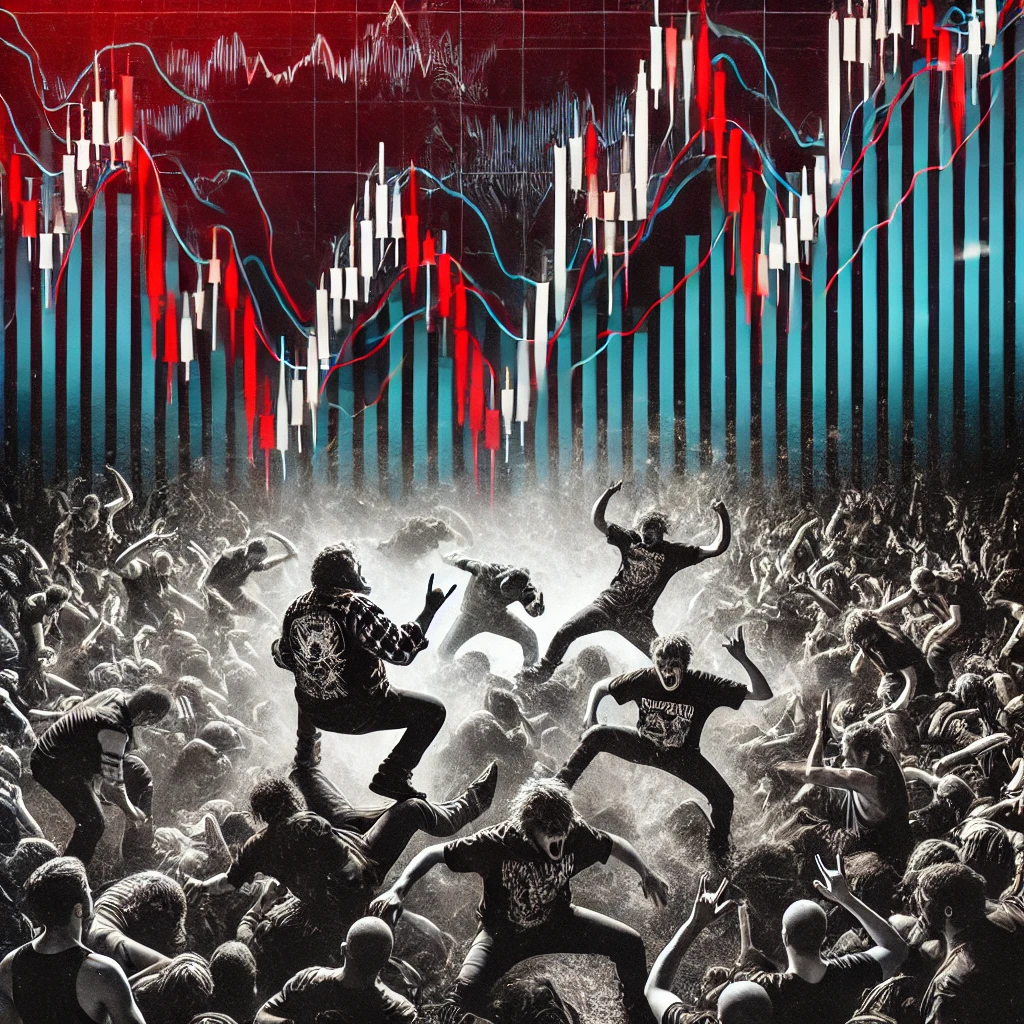
    crowded mosh pit set against a falling stock chart, symbolizing surviving a bear market with a metal mindset

    When the market tanks, crank up the volume—bear markets call for brutal riffs.

    Positioning for the Rebound
    Buying the Dip (Or Holding Until It’s Over)

    Most legendary metal records were forged in tough times—bands channeling real pain into epic anthems. Similarly, bear markets can be prime hunting grounds for savvy investors who spot undervalued stocks. Warren Buffett famously suggests being “fearful when others are greedy, and greedy when others are fearful,” implying that solid bargains emerge when widespread panic pushes prices too low.

    1. Focus on Quality
      • Even the strongest companies can tank in a bear market, but they’re also the most likely to rebound when sentiment flips. Keep an eye on essential industries like energy, healthcare, or innovative tech—think of them as your core rhythm guitar, anchoring your portfolio.
    2. Use Dollar-Cost Averaging
      • If you believe in an asset long term, spread your purchases over time instead of trying to guess the exact bottom. This approach balances out short-term price swings. No one nails the perfect entry point every time, and it’s better to join the song at a decent spot than to miss it entirely.
    3. Diversify with Alternatives
      • Cryptocurrencies or gold can sometimes buck the trend—or at least move to a different drumbeat—during stock slumps. Just be sure you understand the risks before diving in. According to Bloomberg, crypto markets can be even more volatile than equities, so approach them with caution.

    If you do dabble in Bitcoin during the chaos, you might as well stash it in style. A bitcoin-themed coffee mug can serve as a cheeky reminder that while the stock market might be tanking, there’s a whole other realm of digital possibility out there.

    A bear market might knock the wind out of your portfolio, but remember: metalheads don’t shy away from adversity—they crank the volume and plow straight through it. By budgeting wisely, diversifying, and maybe tapping into alternative assets, you can navigate the gloom and come out with some serious investing scars—AKA experience.

    You’ll come away with more than just bruises; you’ll have a refined strategy, a tougher psyche, and maybe even a new perspective on what “value” really means. So the next time red numbers flood your screen, think of it as the breakdown in your favorite song—brutal, intense, but ultimately setting the stage for a crushing comeback.

    In other words, keep your boots laced, your coffee scorching, and your riffs savage. Because a bear market can’t kill your spirit if you’re headbanging right through it.
  • Grindcore & Grind Savings: Making Sense of Micro-Investing Apps Over Your Morning Brew

    Grindcore & Grind Savings: Making Sense of Micro-Investing Apps Over Your Morning Brew

    Raw Energy Meets Small Steps

    Grindcore music isn’t about half-measures—just like metal’s most ferocious subgenre, it’s fast, loud, and relentless. Meanwhile, micro-investing is all about little steps that can build into something massive over time. At first glance, these two worlds couldn’t be more different. Yet if you’re the type to blast unrelenting riffs first thing in the morning, you might find surprising harmony in sipping coffee and automating your spare change into investments. According to NerdWallet, small amounts can compound into significant gains if you stay consistent—much like how tiny bursts of grindcore brutality can form an entire blistering set.

    Morning Brew and Micro-Investing

    Traders often fixate on large-cap stocks and day trading, but micro-investing apps let anyone dip into the market at their own pace. You link a debit card, and every time you buy groceries or snag coffee beans, the app rounds up the purchase and invests the difference. It’s effortless—like a background drum track hammering away while you sip your morning brew. If you want to add a bit more of that rebellious flair to your setup, consider raising a coffee mugs for traders that reminds you to keep grinding (and HODLing) for the long haul. Because even a handful of cents here and there can stack up when you’re consistent.

    Why Grindcore? Why Micro-Investing?

    Grindcore thrives on a do-it-yourself ethos. Bands record in makeshift studios, distribute music through underground channels, and book shows in basements or tiny clubs. Micro-investing apps likewise dismantle barriers to entry. You don’t need thousands of dollars to start—just a smartphone and a willingness to funnel spare change into an ETF or stock slices. Both worlds reject the gatekeeping that says you have to be “rich” or “polished” to participate. The Wall Street Journal once reported on how micro-investing democratizes the market, pulling in folks who might otherwise be sidelined. Just as grindcore invites fans to create their own intense, no-frills music, micro-investing invites everyday people to build wealth incrementally.

    Steps to Get Grinding with Micro-Investing

    Pick an App: Choose a reputable micro-investing platform. Research its fees, user interface, and whether it aligns with your investment preferences.

    Link Your Card: Allow round-ups or periodic transfers. Even one dollar a day can evolve into a considerable stash over time.

    Set and Forget: Like the relentless beat of a grindcore track, consistency is key. You don’t need to tweak the settings daily—just trust the process and occasionally check your balances.

    Channel the Grind: Throw on your favorite blast beat track while you finalize your settings—let the unrelenting drums remind you that little increments, repeated often, become unstoppable momentum.

    Sustaining the Groove

    Maintaining your enthusiasm for micro-investing can be tricky if you’re not seeing big returns right away. Yet the same can be said for discovering a new grindcore band—you might not love it instantly, but over time, the intensity clicks, and you’re hooked. If motivation slips, spice up your coffee routine. Sip from a mom coffee mug just to keep things ironically fun and remind yourself that even a metalhead can have that everyday, caring side. Balance the comedic mug choice with a fierce approach to saving, because the more you treat investing like a daily habit, the more natural it becomes.

    Surviving the Daily Grind (and the Grindcore)

    Every band has off days; every investor sees red in their portfolio at some point. The micro-investing mindset helps you push through. When your spare change invests automatically, you aren’t wrecking your budget or panicking over daily fluctuations. It’s like background noise that eventually builds a massive wall of sound—except this wall of sound can translate to a growing balance over months and years. CNET emphasizes how automating finances helps people save without overthinking. And if the markets tank, you can treat it like a brutal breakdown in a grindcore song—part of the experience, not the end of the world.

    Why It All Works

    Grindcore and micro-investing might sound like a bizarre combo, but they share core principles: efficiency, repetition, and an unyielding spirit. Grindcore condenses songs into short bursts of aggression; micro-investing condenses wealth-building into manageable daily increments. Both rely on consistent, relentless motion. If you can embrace such intensity in your playlist, you can embrace a slow-and-steady investment strategy without losing that rebellious spark. Each round-up deposit is like a blast beat—tiny, fast, and cumulative. Over time, those blasts form a full track, and those deposits form a respectable portfolio.

  • The Lyrics of Extreme Metal: Poetry of Darkness and Despair?

    Ever wondered if there’s more to the guttural growls and blast beats than just… noise? Well, buckle up, because we’re about to dissect the lyrical landscape of extreme metal – from the blackest of black metal to the most brutal of brutal death. I’m Steve, by the way, and I’m here to tell you: there’s poetry in the pandemonium, and it’s often a hell of a lot smarter than people give it credit for.

    Deciphering the Darkness: Common Themes

    Let’s be real: if you listen to metal, you’re probably already familiar with the core themes. Death, destruction, the end of the world as we know it, and the failings of humanity are all mainstays. However, it’s in *how* these themes are approached that things get interesting. Some bands wallow in nihilism, exploring the futility of existence with a bleak, unflinching gaze. Others use these themes as a springboard for social commentary, critiquing war, environmental destruction, and political corruption. Then there’s the whole realm of fantasy and mythology, which often serves as an allegory for modern anxieties.

    The sheer breadth of topics is amazing. A lot of the earliest metal bands were into stories from mythology and, I would argue, were trying to create their own version of a myth. While some themes overlap across subgenres, each one often brings its own take. For instance, black metal tends to lean towards anti-religious themes and the worship of nature, whereas death metal is often more concerned with the gore of physical decay. It all depends on the artist’s vision, their influences, and what they want to communicate.

    Philosophical Underpinnings: Nietzsche, Camus, and Beyond

    It’s not all just mindless screaming, folks. Many extreme metal lyrics are surprisingly philosophical, drawing on the works of thinkers like Friedrich Nietzsche, Albert Camus, and even more obscure theorists. The exploration of existentialism, nihilism, and the absurd is a major theme. You can often find lyrics grappling with questions of free will, the meaning of life (or lack thereof), and the nature of good and evil.

    For example, Nietzsche’s concept of the Übermensch – the individual who transcends societal norms and creates their own values – is a common thread, particularly in black metal. Camus’ philosophy of the absurd, the idea that life is inherently meaningless, yet we must embrace it anyway, also gets explored. The artists use music to communicate their thoughts and the concepts they are studying.

    This might sound like highbrow academic stuff, but remember, the best art reflects reality. I often see a parallel in the stock market – the constant struggle against chaos, the search for order in the face of volatility. It’s all about finding your own path, making your own decisions, and weathering the storms. If you’re looking for a different, more in-depth view, check out this article from the Stanford Encyclopedia of Philosophy: Nietzsche. It’s a tough read, but it is worth it.

    Literary Devices: Beyond the Blasts

    The writers of extreme metal lyrics are often masters of poetic techniques, even if you can’t understand the words at first. They use vivid imagery, powerful metaphors, and alliteration, assonance, and consonance to create a compelling effect. All of these techniques elevate the song’s message beyond the screaming and the drumming. The effect of these devices creates a unique form of poetry.

    Imagery is a big one. Think about the descriptions of a rotting corpse, the desolate landscape, or the fiery depths of hell. These aren’t just descriptions, they’re designed to evoke a specific emotional response in the listener, building an immersive experience. The imagery and creative storytelling can be quite striking. Just as I look at a chart and find patterns and clues, so too do the lyrics offer insight.

    Even the structure of the lyrics matters. Many bands are employing unique song structures and poetic forms to create a memorable experience. All of the different techniques can be a little overwhelming at first. So, go back to the basics and dissect them one by one. It’s like learning to read charts; you have to crawl before you can walk. If you’re interested in learning the basics of poetry, check out this guide from the Poetry Foundation: Poetry Glossary.

    The Controversy (and the Beauty)

    Extreme metal has always been controversial. The violent imagery, the satanic themes (though they’re often just artistic expressions), and the raw aggression have made it a target for criticism. It has been accused of promoting violence, misogyny, and nihilism. However, you can’t judge a book by its cover, and you should not just listen to a song and draw a conclusion. Sometimes, the goal is to provoke thought and start a discussion.

    The truth is far more complex. For many listeners, extreme metal is a cathartic outlet for anger, frustration, and despair. The intensity of the music provides a safe space to explore dark emotions and to process complex ideas. Metal acts as a way to connect. It’s a shared experience that transcends the music itself. It can give voice to people who might otherwise feel alone.

    There’s a surprising amount of nuance and intelligence in the music. Just as a savvy investor needs to look beyond surface-level indicators, anyone who is willing to look beyond the chaos will find beauty, poetry, and even moments of profound insight.

    So, the next time you’re cranking up the volume, remember to listen closely. You might be surprised by what you discover. Who knows, maybe this newfound appreciation of metal will influence your investments. You might start thinking, ‘This is going to make a killing!’ If you’re looking for a perfect way to take notes and plan out your next big investment idea, check out these funny coffee mugs for guys. They will help with your focus and you can look cool while doing it.

  • From Underground to Mainstream: The Economics of Extreme Metal

    The extreme metal scene, with its guttural vocals and face-melting guitar solos, has always been a world unto itself. But behind the blast beats and the breakdowns, there’s a surprisingly complex economic ecosystem. From tiny DIY labels to massive festival stages, the financial realities of keeping the metal machine running are often brutal. I’m Crypto Bro Charlie, and I’m here to break down the numbers, the market forces, and the sheer grit that drives this subculture.

    The DIY Ethos and the Grind

    The origins of extreme metal are rooted in the DIY (Do It Yourself) ethic. Bands started in garages, recorded in home studios, and booked their own shows. This meant minimal overhead, but also razor-thin profit margins. Independent labels played a crucial role, often fueled by passion rather than profit. These small operations were the lifeblood of the scene, taking chances on new bands and nurturing the underground. The economics of the early days were all about survival. Bands relied on touring, merch sales, and the dedication of a fiercely loyal fanbase. Many bands even released albums on their own labels, and did everything from packing the CDs, to selling them online!

    Take a look at this report on the global music industry revenue to see the shifting dynamics within the industry as a whole.

    The constant struggle was finding the balance between artistic integrity and financial stability. Many bands faced the tough choice of staying true to their sound or compromising to broaden their appeal. But for many, the authenticity of the music and the tight-knit community were worth more than any potential payout. They were in it for the love of metal, and that was their primary motivation.

    Labels, Distribution, and the Digital Age

    As extreme metal grew in popularity, so did the need for more professional infrastructure. Labels started to evolve. Major labels began to take notice, and bands saw the potential for broader distribution and greater reach. However, this came with its own set of challenges. Contracts could be brutal, with bands often losing creative control. Distribution deals ate into profits, and the constant pressure to generate sales was immense.

    The digital age changed everything. Streaming services revolutionized how people consumed music, creating new revenue streams, but also shifting the balance of power. Bands now have more direct access to fans, but the royalties from streaming can be meager. Merchandise sales, once a critical source of income, became even more important to generating revenue. Bands had to become savvy entrepreneurs, creating their own brands and marketing themselves online. This shift meant that those who learned to navigate the digital landscape were best positioned to thrive.

    Also, consider the cost of promotion and touring. Both are essential, but are also very expensive. According to recent reports, touring costs have skyrocketed in the last few years.

    Venues, Festivals, and the Live Experience

    The live experience is at the heart of extreme metal. The energy of a live show, the raw power of the music, and the shared experience create a sense of community that is unmatched. Venues, from dingy clubs to massive festivals, are essential to the metal scene’s economy. Small clubs provide a platform for emerging bands, offering a place to hone their craft and connect with fans. Festivals, on the other hand, have become major events, drawing thousands of fans and generating significant revenue.

    However, venues also face challenges. Rising costs, competition for talent, and the need to provide a safe and enjoyable experience for fans can all put a strain on their finances. This is the metal economy in practice; everything is a balancing act. Festivals can be the biggest revenue drivers in the metal scene, but even then, weather, low ticket sales, or unforeseen problems can impact profitability, and bands will often have to work their way out of debt.

    The Future: Crypto, NFTs, and the Next Level

    So, what’s next for extreme metal economics? In the crazy world of Crypto Bro Charlie, I see several opportunities. NFTs could offer a new way for bands to connect with their fans, selling limited-edition music, artwork, and experiences. Cryptocurrencies could provide a new means of payment, bypassing traditional banking systems and giving bands more control over their finances. And the metaverse? Well, that’s a whole other beast… a Lambo-fueled opportunity! The future is uncertain, but one thing is for sure: the extreme metal scene will adapt and innovate.

    It’s like any market: you’ve got to hustle, take risks, and keep pushing. Whether you’re a band, a label, or just a fan, the key is to stay passionate, support each other, and keep the metal flowing. Speaking of essential equipment, I need a coffee. A lot of coffee. And if you need a vessel worthy of your dark elixir, let me tell you about the best option out there.

    Because after a long day of trading, there’s only one thing that can get you through the final hour. If you’re in it for the long haul, I suggest you grab yourself one of those nice coffee mugs.

  • Black Metal’s Cultural Impact: Beyond the Controversy

    The icy tendrils of black metal have wrapped themselves around far more than just distorted guitars and guttural screams. It’s time we peered beyond the often-sensationalized headlines and examined the genre’s truly diverse impact, from the art world to the financial realm (yes, really).

    The Art of Darkness: Visual Echoes

    Black metal’s aesthetic is immediately recognizable: corpse paint, stark imagery, and a fascination with the bleakest corners of human existence. This visual language has seeped into various artistic expressions. Consider the prevalence of monochrome photography, often inspired by Norwegian landscapes, and the use of unsettling symbolism. The visual elements of the genre have influenced graphic design, fashion, and even film, with directors incorporating black metal’s atmosphere to generate feelings of dread and awe.

    This fascination with the morbid and the dramatic isn’t entirely new, of course. Artists throughout history have explored dark themes, but black metal offers a unique blend of aggression, coldness, and a sense of isolation. The raw energy that is poured into black metal art creates a feeling that captures a particular slice of cultural and psychological landscape.

    Some critics may argue that this is all derivative of Romanticism or earlier forms of expression, but black metal’s influence is undeniable. Think about the album art – those evocative, often unsettling images are immediately associated with a specific sound and ethos. You don’t necessarily need to be a fan to recognize the visual style.

    Ideology & Controversy: Navigating the Minefield

    Let’s address the elephant in the room: the controversial association of some black metal bands with far-right ideologies. This has led to accusations of hate speech and a tarnishing of the genre’s reputation. It’s crucial to understand that these views are not representative of all black metal artists or fans, but rather a disturbing, albeit often small, portion of them. We must acknowledge this reality without allowing it to define the whole scene.

    The topic is complex. As highlighted in a report by the Southern Poverty Law Center, the intersection of certain subcultures with far-right ideologies is a subject of ongoing concern and investigation [Source: Southern Poverty Law Center]. Examining how these ideologies intersect with black metal necessitates careful and nuanced discussion. It’s crucial to condemn hateful views while still recognizing the diverse artistic contributions of the genre’s non-affiliated creators.

    Black metal often delves into themes of rebellion, anti-establishment sentiment, and a rejection of societal norms. This, combined with the genre’s exploration of darkness, can provide fertile ground for extremism if it’s not handled responsibly. The history is full of examples.

    Moreover, a closer examination of the history is crucial. Examining the historical background can help clarify the roots and context of the scene. The genre’s roots in Scandinavian folklore and its embrace of nature are often overlooked. This creates a false impression of monolithic belief. While this research may be difficult, and sometimes unwelcome, it remains a critical aspect of understanding the cultural landscape.

    Cultural Cross-Pollination: From Coffee Shops to Crypto

    Black metal’s reach extends far beyond the stage and the record stores. One can find its influence in various subcultures, including streetwear fashion, independent publishing, and even the coffee culture. The genre’s visual aesthetic, with its starkness and rejection of the mainstream, resonates with those seeking alternative expressions. Look at the popularity of dark aesthetics in independent coffee shops.

    Many may not be familiar with all the intricacies of the genre, its history, or all the personalities who helped it grow. This is a good thing. But consider the popularity of such things as Death Metal Mugs. They reflect a sense of belonging and a shared appreciation for the unconventional. Black metal helps to capture a sense of nonconformity and community among fans.

    There are some who believe that black metal will be directly associated with crypto. I, for one, do not. I would never invest in such a chaotic market! I can barely understand how my Apple Watch is supposed to help me manage my investments, let alone something like crypto. It is, after all, a young market that has changed significantly over the last twenty years. But perhaps the genre’s rebellious spirit has something to do with it. It is a constant rebellion to the conventional.

    The Last Word

    Black metal, like any complex cultural phenomenon, is filled with contradictions and complexities. Its impact goes far beyond music, as demonstrated by its influence on various art forms, subcultures, and even societal narratives. It’s a genre that sparks discussions, challenges norms, and often polarizes the audience. It’s my hope that you can engage with black metal on a level that is informed and critical.

    Whether you are exploring a local music venue, taking pictures of dark landscapes, or even enjoying a cup of the finest, darkest roast, you may find yourself influenced by the themes and aesthetics of the genre. Now, if you will excuse me, I must prepare a fresh batch. It’s the only way I can get through the day. I could only imagine this mug filled with a carefully selected dark roast, brewing as the band members are screaming in the background. It’s truly a match made in heaven. And the only way to enjoy it? With interesting mugs of course.

  • The Sociology of the Mosh Pit: Community and Chaos in Extreme Metal

    The pit. It’s where the rubber meets the road, the sweat mixes with the beer, and the raw energy of extreme metal explodes into something tangible. But what’s really going on in there? Sure, it looks like a free-for-all, a swirling vortex of bodies driven by pure, unadulterated sound. But beneath the surface of chaos, there’s a complex social dynamic at play, a community built on shared experience and unspoken rules.

    The Genesis of the Circle

    Think back to your first show. Maybe you were just standing there, taking it all in, feeling the bass in your chest. Or maybe, like me, you got pulled in, and before you knew it, you were caught in the current. The mosh pit isn’t just a random cluster of flailing limbs; it’s a ritual, a communal act that binds metalheads together. It’s a space where the boundaries of personal space are willingly surrendered, where vulnerability is embraced, and where the shared love of the music creates a sense of belonging.

    This isn’t some new phenomenon. The idea of shared experience leading to a bond of some kind has roots way back. For example, early sociological studies examined the phenomenon of shared hardship creating unique communities, and these shared experiences are what form the foundation of mosh pit camaraderie. Many studies now explore how groups with the same goals come together and forge bonds. It’s more than just a concert; it’s a cultural experience.

    According to researchers, these seemingly chaotic moments are actually governed by a complex set of unwritten rules. These include the unspoken agreement to help anyone who falls, the understanding of the “circle of trust,” and the acceptance of the collective release that comes with the experience. It’s fascinating to see how this happens so organically. This helps create a culture of trust, in which people feel safe to let go and express themselves freely.

    The Psychology of the Pit

    The power of the mosh pit isn’t just physical; it’s psychological. It’s a form of catharsis, a way to release pent-up emotions and frustrations. For some, it’s a primal scream, a way to shed the constraints of everyday life and connect with something raw and powerful. The energy of the music, combined with the physicality of the pit, creates a heightened state of awareness, a kind of shared trance.

    It’s a space where anxieties and inhibitions melt away. When you’re in that pit, it’s just you, the music, and the collective energy of everyone around you. It’s a place where you can be yourself, even if that self is a little bit wilder than usual. The experience fosters a sense of belonging, and the shared vulnerability can deepen a person’s appreciation for community.

    The social interaction is worth a look. Researchers from the University of California, Berkeley have focused on the impact of music on people’s ability to empathize and bond with others. Check out some of their research that shows how music builds social cohesion. It shows the surprising neurological effects on how the human brain responds to music and how it influences behavior. The physical environment amplifies it.

    Unwritten Rules and Rituals

    Now, the pit has unspoken rules, too. Helping someone up after they fall? Standard. Not throwing cheap shots? Mandatory. If you’re on the outskirts of the circle, it’s often understood that you are there to provide a buffer, to keep the chaos within reasonable boundaries and prevent injuries. In essence, the mosh pit is an arena of trust, a demonstration of the shared code of metal.

    These rituals vary slightly from scene to scene and from show to show. The rituals are often linked to the music’s specific genre. Hardcore pits, for instance, might have a higher incidence of stage diving and crowd surfing. Black metal might include more theatrical performances. Whatever the specific form, the core values of respect and community remain.

    It’s also about the type of camaraderie that develops when you put trust in other people. The pit’s dynamics are a great example of how social bonds can be forged in unusual circumstances. Some researchers have called it a micro-society that can provide a space for self-expression and social connection. Research from the journal Sociological Perspectives shows how rituals and social dynamics shape communal activities. It is a valuable look at the group dynamics that can arise through ritualized behaviors.

    Beyond the Pit: The Metal Community

    The mosh pit is just one piece of the puzzle. The metal community extends far beyond the confines of the venue. It’s a global network of fans, bands, and enthusiasts who share a common love of the music and a deep respect for the culture. It’s a place where outsiders find a home, where self-expression is celebrated, and where friendships are forged that can last a lifetime.

    The bond that is formed within the context of the concert is unique. People show up to shows as strangers, and they leave with the feeling that they have some kind of shared history. This shared identity is often linked to a band or a particular scene. It’s a connection that transcends geographical boundaries, connecting people around the world. It is what truly sets this community apart, even as it can sometimes look like any other kind of community from the outside.

    The Long Haul

    The mosh pit and the broader metal community are a testament to the power of music to unite and inspire. They are an illustration of how shared experiences can create bonds that run deep, and how a subculture can offer belonging, self-expression, and community. So the next time you find yourself in the middle of the mayhem, take a moment to appreciate the complex social dance that’s unfolding around you. There’s more than meets the eye in there.

    And hey, if you’re trying to get the right level of energy before a metal show, there’s no better way to get started than a strong cup of coffee. You’ll need one, and it might as well be served from a badass coffee mug! I’d suggest picking up some badass coffee mugs to get the ball rolling—that Doge mug I got recently is a serious conversation starter. badass coffee mugs

  • Beyond the Blood: Extreme Metal’s Visual Mayhem

    Corpse paint. Spiked gauntlets. Stage props that could make a Lovecraftian horror blush. For anyone who’s ever caught the eye of extreme metal, the visuals are just as crucial as the sonic assault. It’s a complete package – a statement. It’s a damn near religious experience.

    The Canvas of Chaos: Album Art and Beyond

    Let’s be honest, we’ve all judged a book by its cover. Album art in extreme metal isn’t just eye candy; it’s a visceral introduction to the aural chaos within. It’s the visual prelude to the auditory apocalypse. Consider the iconic artwork of Slayer’s “Reign in Blood” – the blood-soaked, demonic imagery instantly sets the tone. It screams, “Prepare to have your eardrums obliterated!” These visuals tap into the primal subconscious, playing on fears and fascinations.

    This goes way deeper than mere aesthetics; it’s about world-building. Artists like Dan Seagrave, known for his work with bands like Morbid Angel and Suffocation, are masters of this dark art. His work is a portal. His album covers depict hellscapes, gnarled creatures, and scenes of absolute despair. These aren’t just images; they’re invitations to explore the artist’s terrifying universes. The complexity of these images and their meanings goes hand in hand with the complexity of the musical composition.

    The artistry found in album design and other visual concepts for metal bands is an extension of the music’s themes. The design often reflects the lyrics, the overall feeling, the genre, and even the band’s personal life. These choices are also often carefully curated to appeal to the fans, whose support keeps the art alive. This can be seen with the wide use of symbolism. Take a band like Behemoth. Their album art, laden with religious iconography and occult symbols, directly mirrors the band’s lyrical themes of blasphemy and rebellion. It’s a powerful combination.

    Corpse Paint and the Theatre of the Macabre

    Corpse paint – the white face, the black eyes, the inverted crosses – it’s the undeniable uniform. But what’s the point? Sure, it’s shocking, but there is a reason beyond mere shock value. It’s about transformation. It’s the ritualistic face of death, an extreme metamorphosis from the ordinary. The bands become something else, something powerful.

    It’s a theatrical mask. Think of it as a visual gateway, allowing the artists to disappear into their performances. It allows them to transcend the mundane, allowing them to channel the darkest aspects of the human psyche. It’s not about hiding; it’s about revealing something deeper, something primal.

    These visual choices aren’t just random; they have roots. The use of corpse paint, for example, can be linked to the theatrical traditions of mime and kabuki, traditions that require the performer to transform their appearance. To take on a new persona. The use of these traditional concepts to inform a modern act of performance art is a testament to the artist’s creativity. You can see the roots, too, in the traditions of the theatre of the absurd. Britannica dives into these concepts more. It’s a transformation, a performance, a complete immersion.

    Stagecraft: The Amplification of Horror

    The stage setup is your second layer of visual assault. Think massive backdrops depicting hellscapes. Pyrotechnics that would make a pyromaniac jealous. It’s not about playing a gig; it’s about creating an experience. Think of Dimmu Borgir’s stage shows – elaborate costumes, fog machines, and a theatrical presentation that elevates the music into a fully immersive spectacle. They aren’t just playing; they’re summoning demons.

    Stage presence matters. The way the band moves, the lighting, the use of props – everything is carefully choreographed. It’s not just about playing the songs; it’s about controlling the atmosphere, guiding the audience through a journey into darkness. The visual environment has a profound impact on how we experience the music.

    You could be seeing a group like Mayhem, whose early stage performances were notorious for their brutality, or a group like Cradle of Filth, with their gothic, vampiric imagery. Regardless of the band, the stage setup is a visual language that communicates the core values of the artist. It’s an extension of the artist’s personality, musical style, and overall message. The visual and the auditory work in tandem. It is a complete sensory overload.

    Beyond the Surface: Meaning and Message

    Extreme metal’s visual language isn’t just for shock value. It’s a vehicle for expressing complex ideas, exploring taboo themes, and challenging societal norms. Many metal bands use their art to explore themes of societal decay, environmental destruction, and philosophical concepts.

    The imagery is a form of storytelling. It can be a powerful way to communicate complex ideas and emotions. It’s a visual conversation that deepens the experience and enriches the connection between the band and the audience. The visuals are often intertwined with the themes and messages of the music. Taylor & Francis Online dives into the psychology of metal and how the visual presentation can further these ideas. The whole experience is about immersing the listener in the artistic vision.

    The visual aspects of extreme metal are not simply an add-on; they’re an integral part of the artistic whole. It’s a visual representation of the music’s core themes. If you’re planning on being a day trader, you need to be able to immerse yourself in the situation, focus, and grind. You need to take everything in and find the value in it.

    You need a killer cup of coffee to get you through the day. Just like a killer album helps you get through the evening. Which is why I’m always ready to sell you a day trader coffee mug. It is literally a match made in heaven.

  • Beyond the Blast Beats: Musicianship in Extreme Metal

    The untrained ear often dismisses extreme metal as a cacophony of screaming, growling, and what sounds like a runaway garbage truck in a hurricane. However, behind the perceived sonic assault lies a world of astonishing musical complexity. While my classical music tastes often clash with the preferences of my Death Metal Mugs crew, even I, with my refined appreciation for a good cappuccino and Bach, can appreciate the technical skill involved.

    The Illusion of Chaos: More Than Just Noise

    The perception of chaos in extreme metal stems from its high velocity and unconventional structures. The tempos, often reaching the realm of inhuman speeds, combined with the aggressive vocal styles and dissonant harmonies, create an initial impression of raw, unfiltered energy. But this is far from a lack of skill. The musicianship is incredibly demanding, requiring precision, dexterity, and a deep understanding of music theory.

    Many metal drummers, for instance, utilize blast beats, a technique involving rapid alternation between the kick drum, snare drum, and cymbal. This creates the illusion of a continuous, unrelenting barrage. To truly appreciate the technical proficiency, one must recognize the control needed to maintain that tempo for extended periods.

    These players are skilled, dedicated, and have to be, as evidenced by the fact that, according to a 2022 study published in the journal *Psychology of Music*, proficient musicians demonstrate enhanced cognitive flexibility and working memory capacity. [Link to a study about musicians’ brain function] Metal drummers aren’t just hitting things; they’re athletes of rhythm. They’re basically the stockbrokers of the music world, but with fewer loafers and more double bass pedals. I know a thing or two about stamina, having once spent 16 hours a day on the trading floor.

    Compositional Complexity: Beyond Verse-Chorus Structures

    Beyond technical skill, the songwriting in extreme metal often displays a sophisticated approach to composition. While pop music frequently relies on predictable verse-chorus arrangements, many extreme metal bands embrace complex song structures, shifting time signatures, and experimental harmonies. The result is often a highly intricate musical tapestry.

    These compositional techniques challenge the listener and demand active engagement. Bands may integrate elements from classical music, jazz, or even world music, incorporating these influences to create unique and thought-provoking sounds. It is a testament to the creativity of these artists that they can craft entire worlds within the confines of a 3-5 minute song.

    It is often said that “complexity is the enemy of understanding.” However, if we look at the long-term performance of the market, we’ll see that the true enemy of understanding is a lack of research, and not making a plan. This applies to both trading *and* death metal.

    The Vocal Approach: Beyond the Growl

    One of the most striking aspects of extreme metal is the vocal style, which can range from guttural growls to high-pitched screams. These vocal techniques require remarkable control and training, as the vocal cords are pushed to their limits.

    It’s not just about yelling; it is about manipulating the voice to create a specific timbre, convey emotion, and articulate the lyrics. In many ways, these vocalists are akin to operatic tenors, but they are doing it while sounding like a tormented demon. The level of control these vocalists possess can be impressive, but it won’t make them like Beethoven to me.

    I am not sure where they get the power, and sometimes I can’t get them to stop. Regardless, one study by the National Institutes of Health [Link to a study on vocal cord physiology] found that, surprisingly, vocal cord damage in extreme metal vocalists is relatively rare, provided they have adequate training. Turns out, even the most brutal vocal styles require a measure of finesse and technique. I wish some of the brokers on Wall Street had such self-control.

    Embracing the Unexpected

    Extreme metal’s willingness to break musical conventions is one of its most compelling traits. There is a degree of freedom, allowing them to explore a wide range of sounds and emotions. This can lead to some truly extraordinary musical experiences, where the listener is challenged, provoked, and sometimes, even moved.

    The irony is not lost on me that I, a staunch traditionalist, am the one who can appreciate the complexity in a music genre that initially seemed like a wall of noise. I was once told, in my early days as a stockbroker, that all I’d need for success was a good tie and a winning attitude. While the tie didn’t hurt, it was discipline and in-depth research, not superficial appearances, that earned me my fortune. My advice? Approach this music the same way you might approach a cup of really good Ethiopian Yirgacheffe: with an open mind, a bit of patience, and a willingness to be surprised.

    Speaking of things that require a good attitude and an open mind, when the crew comes over to my place, I will be the first to admit my classical music often falls on deaf ears. But hey, at least I can make a killer cup of coffee. And for that, I deserve a men's coffee mugs! After all, even the most brutal musician needs a caffeine fix.