Month: October 2025

  • Navigating the Risks: Security and Regulation in the Crypto World

    Cryptocurrency, that digital frontier, is either the future of finance or a colossal Ponzi scheme. As a retired stockbroker, I’ve seen booms and busts, the tulips of the 17th century, and the dot-com bubble. So trust me when I say: approach crypto with a healthy dose of skepticism and a thermos of strong coffee.

    The Wild West of Digital Assets

    Firstly, understand that the crypto market, despite its rapid evolution, is still largely unregulated. This means less oversight and, consequently, more opportunities for… well, let’s just say less-than-savory characters. The potential for price manipulation, scams, and outright theft is far greater than what you’d find in the traditional markets I used to navigate. Think of it like this: your friendly neighborhood barista is more trustworthy than a group of anonymous developers promising the moon.

    One of the biggest security risks is the potential for hacking. Exchanges can be, and often are, targets for cyberattacks. If a hacker breaches your exchange, your holdings could vanish. Even seemingly safe cold storage wallets aren’t entirely immune if you aren’t vigilant about your security practices. This is where those “not your keys, not your coins” mantras come from – you don’t control your crypto unless you control the private keys. Keep in mind there are real-world consequences and the need for due diligence. Research your platforms and wallets. Look for strong security measures, such as two-factor authentication, and reputation within the crypto community.

    Take it from a guy who survived the ’87 crash. If it sounds too good to be true, it probably is. The hype around crypto can be intoxicating, but it’s crucial to stay grounded. Just because a digital asset has the word “decentralized” in its name doesn’t mean it’s automatically secure or a sound investment. Always do your own research, and consider consulting with a financial advisor before investing a significant portion of your portfolio. Remember, diversified holdings are your friend. It’s the old-school advice that still holds true. Even now, you can mitigate risk by spreading your investments.

    The Shifting Sands of Regulation

    The regulatory landscape is in constant flux. Governments worldwide are scrambling to understand and control this new asset class. The United States, for example, is still grappling with how to define and regulate crypto. The Securities and Exchange Commission (SEC) is taking a hard stance, while other agencies are also trying to find their place in the market. This regulatory uncertainty can create both risks and opportunities. New regulations can boost investor confidence and lead to price increases, but they can also stifle innovation or even make certain cryptocurrencies illegal to trade. The SEC website is a good place to start to stay on top of the latest developments. They have a lot of information on regulatory actions and investor alerts.

    In Europe, the Markets in Crypto-Assets (MiCA) regulation is a significant step toward establishing a comprehensive framework for the crypto market. It addresses issues like consumer protection, market integrity, and environmental sustainability. This will likely provide a model for other jurisdictions to follow. Countries are starting to realize that ignoring crypto is not an option anymore. This can lead to increased security and stability in the market, but also higher compliance costs for exchanges and other crypto businesses. Understanding the regulatory environment in your jurisdiction is crucial. Make sure you are aware of the legal and tax implications of investing in crypto. There’s nothing more annoying than getting your gains wiped out by uncle Sam.

    Moreover, the rise of central bank digital currencies (CBDCs) adds another layer of complexity. These digital currencies, issued by central banks, could revolutionize the financial system, but also pose challenges to the existing crypto market. CBDCs could provide a safer and more efficient alternative to cryptocurrencies, potentially affecting their value and adoption. The market is always evolving.

    Due Diligence: Your Best Defense

    You can’t depend on governments to always protect you. Due diligence is your best defense against the risks of the crypto world. This means taking responsibility for your investments and understanding the assets you’re buying. Begin with research. Don’t trust everything you see on Reddit.

    First and foremost, never, and I mean NEVER, invest more than you can afford to lose. Start small, test the waters, and gradually increase your exposure as your knowledge and experience grow. This applies to every investment, not just crypto. As I’ve said a thousand times to my kids, the greatest wealth is in your mind. Be patient, invest wisely, and do not let fear or greed drive your decisions. Think long-term. Look at the technology behind the currency. Consider the team behind the project, their experience, and their track record. Are they anonymous? Are they transparent? Find out about their security audits, the project’s white paper (if it has one), and the use case.

    Don’t fall for the hype. Question everything. Look for red flags, like promises of unrealistically high returns, or claims that are difficult to substantiate. Read reviews from independent sources. Use a variety of resources, including credible news publications and financial analysis firms, to gather information and form your own opinions. Check if the project has been audited by a reputable third-party security firm.

    Security starts with you. Enable two-factor authentication on all your accounts. Use strong, unique passwords. Be wary of phishing scams and never click links from unknown sources. Keep your software up to date. Keep your private keys safe and secure. Remember, the safest place to store your digital assets is in a hardware wallet, offline.

    Always double-check the recipient address before sending cryptocurrency. Losing your coins to the wrong address is like throwing your money into a black hole.

    The Gil’s Verdict

    The crypto world is a bit like the coffee industry. Both are filled with passionate individuals, complex technologies, and a healthy dose of charlatanism. Navigating both requires diligence and an understanding of the game. You’re going to lose sometimes, and that’s okay. When I started out on Wall Street, I lost plenty. But I learned from those losses and I improved. That’s the key. Always learn from the losses. The crypto market presents both significant opportunities and considerable risks. Approaching it with caution, a healthy dose of skepticism, and robust due diligence will go a long way in ensuring your financial well-being. And hey, if you’re up late trading, you’ll need a brew. Sometimes, you just need a strong cup to get you through the morning.

    Speaking of mornings, you know what I need? A reminder of the joy of a good start. And that’s why, sometimes, you just need a good mug. Like the not a morning person coffee mug. Because, let’s be honest, we’ve all been there.

    So there you have it, straight from the coffee-loving, stock-brokering mouth. Stay informed, stay vigilant, and for the love of all that is holy, don’t put all your eggs in one basket. Now if you’ll excuse me, I believe my hand-ground, triple-filtered, and meticulously brewed cup of Ethiopian Yirgacheffe is calling.


  • From Coffee Beans to Capital Gains: The Value of Nurturing Potential

    From Coffee Beans to Capital Gains: The Value of Nurturing Potential

    Picture the journey of a tiny coffee bean. Planted in nutrient-rich soil, it’s watered, shielded from harsh elements, and carefully tended until it transforms into a flavorful roast. Now think about a fledgling tech startup or an emerging crypto project. They need time, resources, and a bit of faith to blossom into industry powerhouses or even market disruptors. In both cases, the real magic happens when we nurture potential—and that goes for everything from your morning cup of joe to the next big asset in your portfolio.

    Life’s too short for mediocre brews or stagnant investments. If you’re curious how the wisdom of growing quality beans can inform a dynamic investing strategy, buckle up. We’re about to dig into parallels between coffee cultivation and capital gains, and why patience might just be your best ally in both arenas.

    Cultivation and Care

    Beans or Assets: The Principles Are the Same
    Whether you’re raising coffee plants or identifying promising investments, you’ve got to start with high-quality seeds. A coffee farmer looks for beans with strong genetic traits; an investor scouts companies or cryptos with sound fundamentals and a compelling growth story. According to an FAO (Food and Agriculture Organization) report on global coffee production, the health of the soil and the climate around the bean can significantly impact yield and flavor. Substitute “soil and climate” with “market conditions and regulatory environment,” and you have a pretty solid parallel for what shapes a company’s potential.

    Time and Patience
    Just as coffee cherries don’t ripen overnight, the companies you invest in won’t skyrocket immediately. If you plant a seed and expect it to become a towering tree by tomorrow, you’re setting yourself up for disappointment. The same goes for buying into a stock or crypto. Sure, there are hype-fueled moonshots that blow up in weeks, but that’s more the exception than the rule. According to a study from Morningstar, long-term holding often outperforms short-term trading, underscoring the payoff of letting growth compound over time.

    It’s like sipping your morning brew from cute coffee mugs: you wouldn’t burn your tongue by chugging it instantly. Instead, you enjoy the warmth, aroma, and taste at a steady pace. If you’re willing to be patient, you’ll savor the entire experience—and give your investments room to breathe.

    Roasting and Timing

    Hitting the Sweet Spot
    In coffee roasting, finding that sweet spot is critical. Roast too long, and the beans turn bitter. Pull them out too soon, and they taste underdeveloped. The same principle applies to deciding when to buy, hold, or sell an investment. Timing isn’t about being psychic; it’s about recognizing certain signals—like the bean’s color, crack, or aroma in coffee, or a company’s earnings, market sentiment, and product launches in the stock world.

    Over-roasted beans and over-held stocks can both leave a sour taste. That’s why your research needs to be on point. Know the bean variety (or company fundamentals), monitor the roast temperature (market conditions), and decide when you’ve got something that’s just right for your palate (profit target or exit strategy).

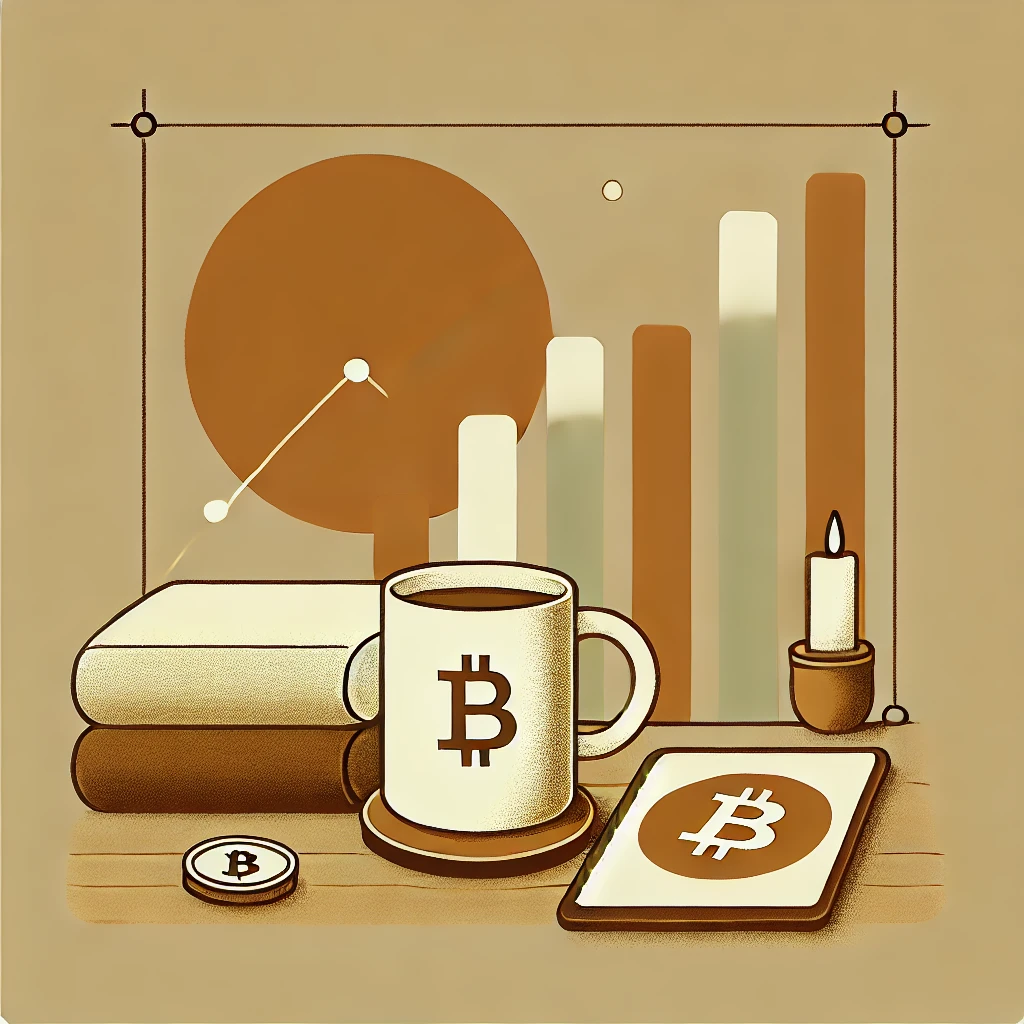
    yellow coffee mugs near fresh coffee beans and a rising stock chart, symbolizing growth and nurturing potential

    Foster the bean, foster the balance sheet—patience grows profits.

    Ongoing Maintenance

    Tending the Crop, Tending the Portfolio
    Coffee farms don’t stop caring for the plants once they sprout. They prune, fertilize, and shield the beans from pests and harsh weather. Likewise, a portfolio isn’t a “set it and forget it” operation if you’re serious about gains. Periodically check in, rebalance, and prune out underperformers. And, as any seasoned investor knows, “weather” can take many forms—recessions, regulatory crackdowns, or unexpected tech breakthroughs that shake up entire sectors.

    During these check-ins, it helps to keep a positive outlook—especially if your positions have dipped. Lift your spirits with yellow coffee mugs that bring a burst of optimism to your routine. After all, nurturing potential is as much about mindset as it is about technical skill.

    Research, Adapt, Repeat
    Don’t assume today’s conditions will stay the same tomorrow. A climate shift can ruin your coffee crop just as a major competitor can tank your investment. Stay curious, keep learning, and be willing to tweak your approach. Sometimes, that means adjusting your brewing method for a new roast; other times, it means pivoting out of a sector when fundamentals change dramatically.

    From coffee beans to capital gains, the journey is about nurturing potential. Each step—selection, cultivation, timing, and ongoing care—mirrors the path of shepherding a tiny seed into something robust and valuable. If you’re patient, committed, and willing to adapt, you’ll often find that both your morning brew and your investment returns are richer than you could have imagined.

    In an age of instant gratification, embracing the slow-and-steady approach can feel revolutionary. But let’s face it: some of the best things in life take time to develop, whether it’s the depth of flavor in a freshly roasted bean or the incremental growth of a company poised for greatness. So next time you savor your coffee, remember that you’re also perfecting the art of patience. And in the world of investing, a little patience just might lead to your strongest returns yet.

  • Unpacking Crypto Mining and Staking: Your Guide to Rewards & Risks

    Cryptocurrency mining and staking are the backbone of many blockchain networks, the engines that keep the digital money flowing. They are also, as you probably already know, opportunities to earn crypto. Let’s peel back the layers and take a look at what makes these concepts tick and what you need to know before you start.

    The Basics of Crypto Mining

    Mining, in the simplest terms, is the process of verifying and adding new transaction records to a blockchain. Think of it as a digital accounting system. Miners use powerful computers to solve complex mathematical problems. The first miner to solve the problem gets to add the new block of transactions to the chain and is rewarded with newly minted cryptocurrency. This is how Bitcoin, for instance, is created.

    The intensity of the effort required in mining means that it can also become a very expensive pursuit. Mining requires a significant investment in specialized hardware (ASICs, Application-Specific Integrated Circuits) and electricity. Because of the energy consumption, Bitcoin mining, in particular, has drawn criticism for its environmental impact, but mining does also play a crucial role in securing the network from fraud and double-spending.

    The profitability of mining depends on several factors: the price of the cryptocurrency, the cost of electricity, and the mining hardware’s efficiency. As more miners join the network, the difficulty of the mathematical problems increases, making it harder and more expensive to mine. This creates a competitive environment where only the most efficient operations can consistently turn a profit.

    I find it interesting to note the scale of electricity consumption, which can be massive. For a detailed breakdown of Bitcoin’s energy consumption, check out the Cambridge Centre for Alternative Finance Bitcoin Electricity Consumption Index, which provides real-time data and insights.

    Understanding Crypto Staking

    Staking, unlike mining, doesn’t require specialized hardware. It’s a process where you hold cryptocurrency in a wallet to support the operations of a blockchain network. Think of it as lending your crypto to the network. In return, you receive rewards, much like earning interest on a savings account.

    Staking is primarily associated with cryptocurrencies that use a Proof-of-Stake (PoS) consensus mechanism. In PoS systems, the probability of a validator being selected to add the next block to the blockchain depends on the amount of cryptocurrency they’re staking. The more you stake, the higher your chances of earning rewards.

    The rewards for staking are typically generated from transaction fees and newly minted coins. The amount of rewards you can earn depends on the specific cryptocurrency, the amount you stake, and the duration for which you stake it. Staking can provide a passive income stream, but it also comes with risks.

    There is also what is called “locking in” your assets, meaning that you can’t access them for a set period. Another risk is something called “slashing,” which means the loss of your staked assets if you are found to be acting dishonestly. Finally, you have the risk of the value of your staked cryptocurrency fluctuating.

    Staking can be less resource-intensive than mining, making it more environmentally friendly. It’s also accessible to anyone who owns the cryptocurrency, making it a more inclusive way to participate in securing a blockchain network.

    Mining vs. Staking: A Side-by-Side Comparison

    Let’s break down the key differences between mining and staking:

    • Hardware: Mining requires specialized hardware (ASICs), while staking requires holding cryptocurrency.
    • Energy Consumption: Mining is energy-intensive; staking is less so.
    • Rewards: Mining rewards come from block rewards and transaction fees; staking rewards come from transaction fees and newly minted coins.
    • Risk: Mining has high upfront costs and the risk of hardware obsolescence; staking has the risk of fluctuating cryptocurrency prices and potential “slashing.”
    • Entry: Mining requires technical knowledge and capital; staking is more accessible.

    Both mining and staking play vital roles in maintaining the security and functionality of different blockchain networks. Understanding the differences can help you determine which activity best suits your investment goals and technical capabilities.

    The Risks of Crypto Mining and Staking

    Before jumping into either mining or staking, it’s essential to understand the associated risks. Mining faces price fluctuations and hardware depreciation. The price of crypto can tank overnight, and your gear may be unable to keep pace with better mining machines. The market moves fast, and the landscape is always changing. It takes diligence and smart planning to make it work long-term.

    Staking also has its share of risks. There is the risk of smart contract exploits or hacking. If the price of your staked crypto goes down, you may lose some of the profits. If you plan to stake, be certain to select only those exchanges or platforms that have a solid reputation, as some platforms have gone under in the past. This is why you need to do your research, and don’t be afraid to take your time.

    Getting Started: Your Next Steps

    Alright, so you’ve got a handle on the mining and staking thing. So, you’re ready to jump in, eh? Before you get started, here are a few things to keep in mind:

    1. Research Thoroughly: Invest time in understanding the specific cryptocurrency you’re interested in mining or staking. Research the team and development to find out if you want to be a part of it.
    2. Choose Reputable Platforms: If staking, use reputable exchanges or staking pools. Verify that their reputation is solid and that the crypto is safe and secure.
    3. Risk Management: Always start small and diversify your holdings. Don’t put all your eggs in one basket.
    4. Security: Secure your wallets and hardware. Use strong passwords and enable two-factor authentication.

    While this is by no means an exhaustive guide, it should get you started in the right direction. For more information, you might also want to look into the regulatory perspective. The U.S. government offers resources that explain what you need to know. For more information on the latest regulatory developments, you can check out the Financial Crimes Enforcement Network (FinCEN) website.

    Now, if you’ll excuse me, I’m off to get another cup of black coffee – keeps me sharp. Sometimes, you just need a caffeine boost to handle the market volatility, right? It’s the only thing that keeps me sane and the markets moving smoothly, along with my other tools. Speaking of tools, here’s one I rely on to stay on track.

    Some days, the markets feel like a total grind, so at least I can have a

    really funny coffee mug while I’m at it.

  • The Tokenomics of Success: Designing Successful Crypto Projects

    Tokenomics, bruv. It’s the buzzword, the lifeline, the whole damn shebang when we’re talking about crypto. Forget moonshots built on hype alone; the real winners, the ones that actually survive and thrive, are built on solid tokenomics. But what the hell are they, and why should you, a self-respecting degen like myself, give a toss?

    Deciphering Tokenomics: The Basics

    Think of tokenomics as the DNA of a crypto project. It’s the blueprint that dictates how a token is created, distributed, and used within its ecosystem. It covers everything from the total supply of tokens to how they’re allocated to the team, investors, and the community. Understanding this is key because it directly impacts a project’s long-term sustainability and, more importantly, your potential gains. A well-designed tokenomic model creates incentives for everyone involved to participate and contribute to the project’s growth.

    At its core, tokenomics is about the economics of a digital asset. This includes the token’s utility (what it’s used for), its supply and demand dynamics, and the mechanisms that encourage adoption and usage. Does the token have a clear purpose? Does its value increase as more people use it? These are the questions we need to ask. A well-structured tokenomic system aligns the incentives of all participants, from the developers to the users, creating a virtuous cycle where success breeds success.

    The Importance of Supply and Demand

    Supply and demand, baby! It’s Economics 101, but in crypto, it’s amplified on steroids. A project can have the flashiest tech and the most dedicated team, but if its tokenomics are whack, it’s destined for the graveyard. Imagine a massive token release schedule that floods the market with new tokens, driving the price down. Or, even worse, what if there’s no real demand for the token? These scenarios are a recipe for a rug pull.

    One of the critical elements of tokenomics is understanding the token’s total supply and the distribution model. Is the supply capped? This can be a good thing, because it creates scarcity, potentially driving up the price over time, as long as demand is there. Or is it inflationary, with more tokens being minted over time? This can be okay too, particularly in projects that need to reward participation or fund growth. The key is transparency and a clear understanding of how the supply will change over time. Projects should spell this out explicitly in their whitepapers and on their websites. A good whitepaper is essential when you’re looking for projects. A solid whitepaper is your bible.

    For example, if you’re evaluating a project, pay close attention to the vesting schedules for team members and early investors. Are they locked up for a reasonable period? Or can they dump their bags on the market and leave you holding the bag? Proper vesting schedules are designed to prevent massive sell-offs early on, which can crater the price and kill a project before it has a chance to prove itself. Investopedia has some great info about vesting schedules if you’re still confused.

    Different Token Models: A Quick Overview

    Token models vary, just like music genres. Each model comes with its own potential upsides and downsides. Different token models can drive completely different outcomes.

    Utility Tokens: These are the workhorses. They give holders access to a specific product or service within the project’s ecosystem. Think of them as in-app currency or membership tokens. A good example is a token that grants access to exclusive content or a service. The value of a utility token is tied directly to the success of the project – the more users and demand, the higher the value. The downside is that they can be subject to regulatory scrutiny because regulators sometimes see them as unregistered securities.

    Governance Tokens: These tokens give holders a say in the project’s future. Holders can vote on proposals, protocol changes, and other decisions. It’s like being a shareholder in a decentralized company. Governance tokens put the power in the hands of the community, which can lead to greater engagement and long-term sustainability. However, they can also be subject to manipulation or concentration of power if a few large holders control a majority of the tokens. They can also create conflicts of interest if the founders and early investors hold a large portion of the tokens.

    Security Tokens: This is where it gets interesting, and potentially risky. Security tokens represent ownership of an underlying asset, like a share in a company or a real-world commodity. They’re subject to securities regulations and often require KYC/AML (Know Your Customer/Anti-Money Laundering) compliance. They’re meant to work in the “real world”, but they’re highly regulated and can be complex to navigate, making them more of a long-term play. But if you’re looking for stability, this is not the place to look.

    Spotting the Red Flags

    We’re all about those 1000x moonshots, but even the most hardcore degens need to be smart about what they buy. There are some serious warning signs. You need to know what to look for when you’re doing your research, so you don’t get rekt by bad tokenomics. One of the main things you should do, is research, and when I say research, I mean go deep. Don’t be like those clowns that buy a crypto because of a celebrity endorsement. Those guys are fools. They’re just setting themselves up for a fall. Here’s what to watch out for:

    Excessive Token Supply: A massive supply can dilute the value of your holdings, especially if there’s not enough demand. If there are billions or trillions of tokens with no real use case, run like hell.

    Unrealistic Emission Schedules: A project with a huge number of tokens being released in a short amount of time is designed to enrich early investors at the expense of everyone else. It’s a pump-and-dump scheme.

    Lack of Transparency: If the team doesn’t clearly explain their tokenomics, whitepaper is vague, and the distribution model is opaque, it’s a big red flag. A legitimate project will be upfront about everything.

    Team Holds a Disproportionate Amount: If the team holds a massive chunk of the tokens and doesn’t have a solid vesting schedule, they could dump their holdings at any time. This is a classic rug pull signal. Make sure they’ve got skin in the game, literally.

    The Path to Crypto Riches (And Avoiding the Dumpster Fire)

    Tokenomics is not a perfect science. Crypto is volatile, and even the best-laid plans can go sideways. But understanding tokenomics gives you a huge edge. It helps you assess risk, identify potential winners, and avoid the projects that are destined to fail. To become a successful crypto trader, you need to be prepared to do your research, and you need to be honest with yourself about your risk tolerance. It’s high risk, high reward, and there is no free lunch. So DYOR, follow the smart money, and never invest more than you can afford to lose. And most importantly, stay frosty.

    But when all that research has got you feeling like you’re staring into the abyss, and you need a break? Well, I know how to wind down. Nothing helps me relax like a solid death metal album and my favorite Death Metal Mugs modern coffee mug filled with the strongest, blackest brew possible. That is how I recharge and prepare for the next battle, bruv!

  • Understanding Blockchain Technology: The Foundation of Crypto

    Decentralization. Transparency. Immutable records. These buzzwords have become synonymous with the world of crypto, but behind the hype lies a technology that’s far more revolutionary than many realize. I’m talking about blockchain, the very foundation upon which the digital asset world is built. And yes, while I still can’t tell you what the hell a ‘meme coin’ is, I can offer a clear-eyed view on the tech itself.

    The Genesis Block: What is Blockchain?

    Simply put, a blockchain is a distributed, decentralized, and public digital ledger. Think of it as a shared database that’s replicated across a network of computers. Each “block” in this chain contains a set of transactions, and once a block is added, it’s chained to the previous one, creating a chronological and tamper-proof record. This “chain” is what makes it so secure, because altering a single block would require changing all subsequent blocks, and that’s an enormous computational undertaking.

    It’s important to understand the concept of decentralization. Unlike a traditional database controlled by a single entity, a blockchain is maintained by a network of participants. This eliminates the need for a central authority, making it more resistant to censorship and fraud. The data isn’t held in one place; it’s spread across numerous computers, making it extremely difficult to manipulate or corrupt. And yes, this is a beautiful thing. We’re talking about a level of transparency that, if leveraged correctly, could change the world as we know it.

    The Core Principles: How Blockchain Works

    At its heart, blockchain operates on a few key principles. First, there’s cryptography, which is the use of complex mathematical algorithms to secure and verify transactions. These algorithms ensure that the data within each block is encrypted and protected from unauthorized access. Second, the consensus mechanism is how the network agrees on the validity of new blocks. Various methods exist, such as Proof-of-Work (used by Bitcoin) and Proof-of-Stake (used by many other cryptocurrencies). Lastly, the concept of immutability is essential. Once a block is added to the chain, it’s extremely difficult, if not impossible, to alter.

    The beauty of this system is that it’s designed to be transparent yet secure. Every transaction is recorded, and the whole history of the chain is open for anyone to see. However, the data is anonymized, so individual identities are generally not directly revealed. The consensus mechanism is critical because it ensures that all participants agree on the validity of each transaction. This eliminates the need for a trusted third party, which is a major innovation.

    Beyond Bitcoin: Applications of Blockchain

    While Bitcoin is the most well-known application of blockchain, the technology has far broader implications. One area where it’s making significant inroads is supply chain management. Companies can use blockchain to track goods from origin to consumer, increasing transparency and reducing counterfeiting. The immutable nature of the technology ensures the integrity of the data, providing a verifiable record of a product’s journey. According to a report by Gartner, blockchain technology will generate an estimated business value of over $3 trillion by 2030 [Gartner – Blockchain Value].

    Furthermore, blockchain is being used in areas like digital identity management, where it can provide a secure and verifiable way to manage personal information. It’s also being utilized in voting systems to enhance transparency and reduce fraud. Furthermore, it is transforming industries such as healthcare, where it’s used for securely storing and sharing medical records.

    Blockchain in the Financial Sector

    Blockchain is making waves in the financial sector, promising to streamline processes and reduce costs. The use of smart contracts, self-executing contracts written into code, can automate many financial transactions, such as payments and settlements. This reduces the need for intermediaries, lowering transaction fees and speeding up processing times. These smart contracts, as defined by the European Commission, can automate and enforce the terms of an agreement, creating a more efficient and transparent system [European Commission – Blockchain].

    However, the application of this technology isn’t without its challenges. The scalability issues, regulatory hurdles, and energy consumption of some blockchain networks are ongoing concerns. The crypto market volatility and sometimes wild hype have also presented issues. It’s a brave new world, and while I can’t exactly predict the future, I can promise it’ll be a wild ride. But be warned: don’t go betting your retirement on Shiba Inu coins.

    The Future of Blocks

    The future of blockchain is undeniably bright. As the technology matures, we can expect to see more innovative applications emerge across various industries. From improving supply chains and protecting intellectual property to enabling more secure and efficient financial systems, the potential is vast. The evolution of blockchain is an exciting prospect. But the real lesson from all of this is that if you’re going to try and explain blockchain to your buddies at the bar, just keep it simple, and maybe have another cup of coffee.

    Speaking of things that are simple, you can always count on getting a great coffee experience, even if you’re a total newbie to the whole blockchain thing, with a truly killer mug from Death Metal Mugs. And if you’re going to be up late, trying to learn this crypto thing, you might as well drink your coffee from a black metal coffee mugs.

  • HODLing the Grind: Long-Term Crypto Mindset Meets Caffeine’s Endurance

    HODLing the Grind: Long-Term Crypto Mindset Meets Caffeine’s Endurance

    Most people sip coffee for a quick jolt, just like some traders buy crypto hoping for fast riches. But if you’re the kind of person who slowly savors your brew—letting its warmth and intensity build—chances are you’ll appreciate the true art of HODLing, or holding onto your crypto for the long haul. Despite the wild ups and downs, real success in digital assets often comes from patience and trust in your strategy. And hey, the same is true for coffee. One is about letting your investments mature, the other is about letting the aroma and flavor fully bloom. Combine both, and you’ve got an endurance game that stretches far beyond your morning routine.

    Why Long-Term Mindset Matters

    Let’s be honest: nobody’s jaw drops at a five-minute crypto scalp or a microwaved cup of coffee. Real depth comes from letting things develop over time, be it a well-drawn espresso shot or a promising altcoin.

    In crypto, the HODL concept rose from a famous forum post where someone typed “HODL” instead of “hold” in a moment of frustration—yet it captured the essence of not selling in panic. Today, HODLing is practically a lifestyle. According to CoinDesk (a major crypto media platform), many enthusiasts cling to their coins through bull and bear cycles, believing in the technology’s future value more than they fear market plunges. That unwavering conviction is like refusing to switch to decaf, even if everyone around you raves about “lightening up.”

    Zooming Out

    Markets fluctuate dramatically day to day, but if you zoom out on a multi-year chart, you see the bigger trajectory. Just like if you give that French press a few extra minutes, you end up with a richer, more complex flavor. Think of it this way: you can stare at the 15-second chart, or you can trust your research and your chosen altcoin’s fundamentals. The second approach might require more patience, but it tends to reward those who stay the course.

    The Role of Caffeine in Your Productivity

    Let’s face it: an all-night crypto research session calls for a robust coffee supply. While some folks guzzle cup after cup just to stay awake, there’s a smarter way to keep yourself fueled.

    Moderation, Not Mayhem

    According to the Mayo Clinic, up to 400 milligrams of caffeine per day is generally safe for healthy adults, which translates to about four cups of brewed coffee. Any more than that, and you risk the jitters, headaches, or even worse—making impulsive crypto trades when your brain’s on overdrive.

    Instead, space out your coffee intake. Start with a strong brew in the morning while checking the latest market updates, savor it in a coffee mug for women that suits your style—because who said a “mom mug” can’t hold the fort for a serious crypto investor?

    Sustained Energy for the Long Haul

    Sipping your coffee slowly can maintain an even caffeine level in your bloodstream, just like dollar-cost averaging can keep your crypto portfolio balanced. If you gorge on caffeine all at once, you might get a quick high, but a crash lurks just around the corner—mirroring the short-term trader who chases moonshots and panics when the chart dips.

    Unwavering Belief—Coffee Rituals & Crypto Conviction

    Daily coffee rituals can be as potent as daily check-ins on your long-term investments. You don’t brew a pot of coffee expecting it to morph into tea halfway through. Similarly, you don’t buy into a crypto project expecting it to be something entirely different next week. You pick your beans (and your blockchain) carefully, then commit to the process.

    • Routine: Brew at the same time each day, check the market with disciplined regularity.
    • Patience: Let the coffee steep properly; let your investments ride out the highs and lows.
    • Conviction: Trust the quality of your beans and the fundamentals of your chosen altcoin.

    When the market crashes or your coffee supply runs low, staying composed is everything. If your caffeine stash is nearing empty, it’s time to re-up that bag of premium roast. If your coins take a dip, it’s time to confirm whether your long-term thesis still holds. Just like you don’t abandon your favorite brew at the first bitter note, you shouldn’t ditch your long-term investments at the first sign of FUD (Fear, Uncertainty, and Doubt).

    Sometimes, you need a visible reminder to keep the faith—both in your brew and your portfolio. Settle into your office chair with dad coffee mugs that say, “I’ve got responsibilities, but I’m still a rebel at heart.” After all, dad jokes and diamond hands can coexist perfectly in this weird world we call adulthood.

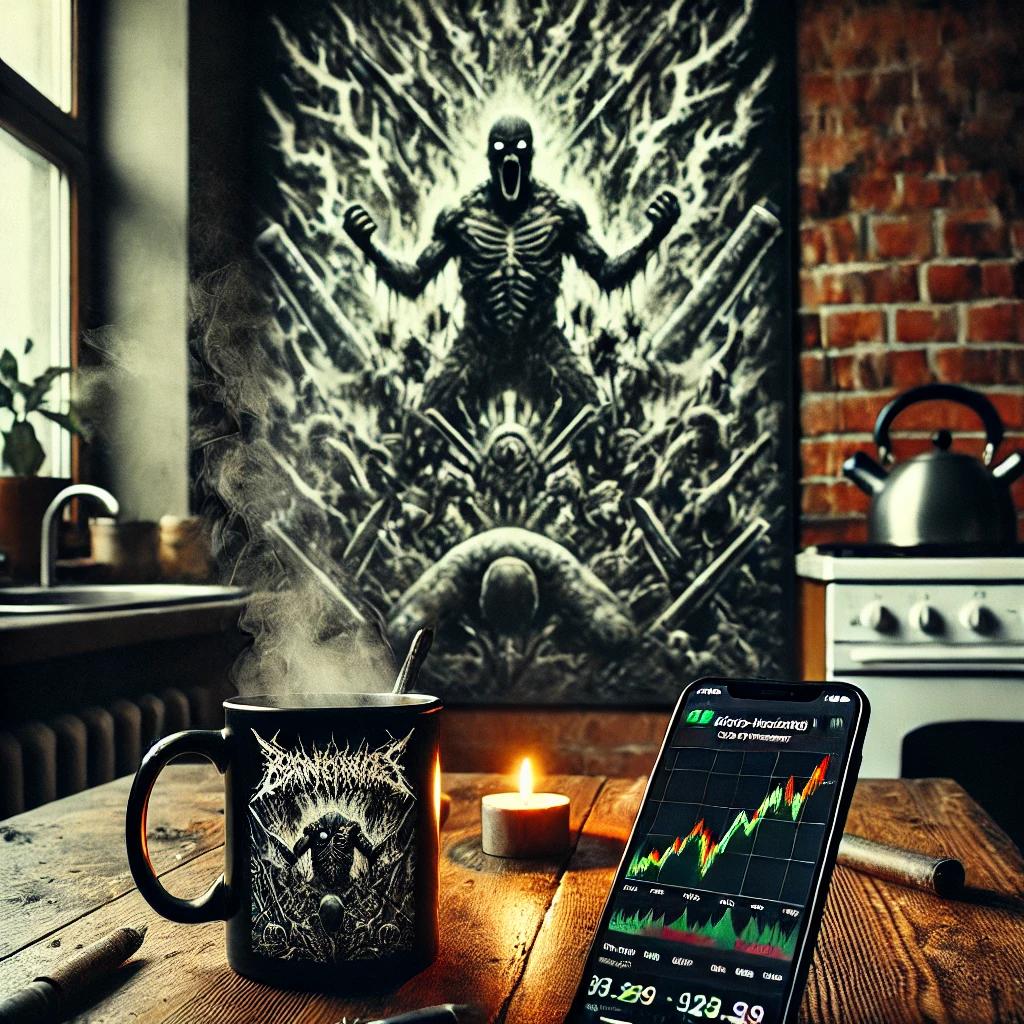
    dad coffee mugs used for relaxed crypto investing with a laptop chart

    Steady brew, steady gains—welcome to the HODL lifestyle.

    At its core, HODLing is about faith, patience, and preparation—the same virtues that elevate a simple cup of coffee into a sacred morning ritual. You don’t brew your coffee with the expectation of gulping it all down in five seconds; you sip slowly, relishing every note. Your approach to crypto should be no different. Whether you’re letting the grounds steep a little longer or letting your altcoin ride out the turbulence, the principle is the same: trust the process.

    Crypto hype may come and go—just as the popularity of various roasts might wax and wane—but the real winners are those who keep an unwavering vision. Once you embrace the methodical grind, you’ll find that the synergy between a killer cup of coffee and a well-researched coin is more than just coincidence. It’s a lifestyle of patience, strategy, and savoring each incremental gain. Because at the end of the day, a well-timed sip and a well-timed HODL can both taste oh-so-sweet.

    Follow my blog with Bloglovin

  • Cryptocurrency and the Future of Finance: A Paradigm Shift?

    Cryptocurrency has sparked a debate: Is it a revolution or a risk? Crypto’s potential to reshape how we handle money, from global transactions to personal investments, is undeniable. But as a stock trader who’s seen a few market cycles, I’ve got some thoughts on where this is all heading. Let’s cut the fluff and get down to brass tacks.

    The Decentralization Dream

    The core concept of cryptocurrency is brilliant: a decentralized system that bypasses traditional financial institutions. This appeals to the rebels, the tech-savvy, and anyone tired of corporate oversight. This dream is about taking control back, cutting out the middleman, and having more direct influence. But let’s be real—the current state of crypto isn’t quite as simple as the headlines make it seem.

    One of the core promises is enhanced privacy and security. Transactions recorded on a blockchain are, in theory, transparent yet pseudonymous. This is in contrast to traditional banking, where your data is often managed by a central authority. This also means you are responsible for your own security, and if you mess up, good luck getting your money back.

    The decentralization movement also aims to promote financial inclusion. Cryptocurrency can reach populations underserved by traditional banking. People in countries with unstable currencies can use crypto as a hedge against inflation. This opens up opportunities for global trade and investment, creating greater equality and breaking down barriers. It’s not a silver bullet, but it’s a step.

    The Volatility Vortex

    While decentralization offers a lot of upside, the volatility of cryptocurrency is its biggest hurdle. Bitcoin and other digital assets can experience wild price swings, often based on speculation or market sentiment. One minute you’re riding high, the next you’re underwater. This makes it difficult for mainstream adoption, as businesses and individuals are reluctant to use a currency that can lose significant value overnight.

    The price swings are often due to the lack of regulation and institutional investment that is a cornerstone of the traditional market. It is important to note that many regulations are being worked on for crypto; however, the wild, speculative nature of crypto isn’t going away. This instability is a major turn-off for the conservative investor. And, let’s be honest, it causes some pretty serious emotional stress. I find that when I feel like I am too heavily invested, I need to remind myself to take a step back and have a beer…or a solid cup of black coffee.

    Another factor is the lack of widespread acceptance. While many businesses accept Bitcoin, it’s still not as ubiquitous as traditional currencies. This limits its usability and, therefore, its practical value. Sure, it’s great for online transactions, but try paying your rent or buying groceries with Bitcoin. Not so easy.

    Regulation and Institutional Adoption

    The tide is turning, though. As the crypto market matures, regulators are stepping in. The lack of clear guidelines has created a Wild West environment, but this is slowly changing. The U.S. government, for example, is actively working on regulations to govern the industry and protect consumers. The Securities and Exchange Commission (SEC) is at the forefront of this effort, grappling with the complexities of digital assets and attempting to bring order to the chaos. This regulatory environment is crucial, but it also creates uncertainty.

    Institutional investors are also starting to dip their toes in the water. Companies like MicroStrategy and Tesla have invested heavily in Bitcoin, signaling a shift in perception. Banks are exploring crypto custody services. But the full embrace of institutional money will likely hinge on clearer regulatory frameworks and greater market stability. This could result in a smoother ride, and help to reduce the volatile swings.

    The adoption of cryptocurrency into the financial world is a slow burn, not a wildfire. It’s a marathon, not a sprint. Any new technology will face the same uphill battle, and crypto is not immune. But the promise of a more inclusive, efficient financial system is worth watching.

    The Technological Leap

    At its heart, crypto is a technological revolution. Blockchain technology, the backbone of most cryptocurrencies, offers a secure and transparent way to record transactions. This has applications far beyond currency: supply chain management, voting systems, and digital identity verification. This is what many people find exciting: the potential for blockchain to reshape the way we interact with technology and the world around us.

    The development and progress of blockchain technology is also very interesting. Projects are in the works to increase the speed and efficiency of blockchains, and solve issues such as high energy consumption. These advancements will only serve to fuel the adoption of cryptocurrency and blockchain technology.

    But like any cutting-edge tech, blockchain has its drawbacks. Scalability is a major challenge; many blockchains can’t handle a large volume of transactions. Energy consumption, especially for proof-of-work cryptocurrencies like Bitcoin, has raised environmental concerns. Finding solutions to these issues will be key to unlocking the full potential of crypto.

    The Future is Now

    So, where does this leave us? Cryptocurrency is not a fad; it’s a technological and financial experiment that’s changing the landscape. The Federal Reserve is keeping a close eye on crypto, monitoring its impact on traditional finance. While the future is still unwritten, the trajectory is clear.

    The smart money is diversifying, doing their research, and not chasing every shiny object. I’m keeping my eye on the market, ready to ride the waves. But remember, any investment carries risk. Don’t bet the farm. Don’t trade what you can’t afford to lose. And most importantly, stay informed and stay skeptical. You need to keep up with the changes. The best way to do that is to make sure you have the best tools to help you stay ahead, so keep a close eye on the markets and have a good cup of coffee as you do.

    And when you’re working the charts late into the night, there’s nothing better than a strong cup of joe in your favorite mug to keep you going. Grab a Death Metal Mugs mug and see if it doesn’t improve your trading game!

  • Beyond Bitcoin: The Rise of Altcoins and Their Impact

    Forget the dusty, boring world of Bitcoin – altcoins are where the real party’s at, bruv. Crypto’s evolved, and if you’re still stuck in the early 2010s, you’re missing out. This ain’t your grandpa’s portfolio; it’s a volatile, chaotic, and exhilarating market ripe for the taking. We’re talking moonshots, Lambos, and the sweet, sweet taste of a 1000x gain.

    The Altcoin Avalanche: Innovation Unleashed

    So, what exactly *are* altcoins? They’re basically any cryptocurrency that isn’t Bitcoin. And trust me, there are a hell of a lot of them. This isn’t just about different flavors of digital money; it’s about a whole ecosystem of innovation. We’ve got decentralized finance (DeFi), non-fungible tokens (NFTs), and a whole alphabet soup of projects aiming to disrupt everything from finance to art. The sheer pace of development is mind-blowing. One minute you’re trading a promising new token, and the next, it’s already got a decentralized exchange, a staking platform, and a roadmap that makes you dizzy. And honestly, it is absolutely brilliant.

    The beauty of altcoins is their diversity. They’re solving real-world problems, from streamlining supply chains to giving artists more control over their work. Some are even trying to address the environmental impact of Bitcoin’s energy consumption. This constant churn of new ideas and technologies is what makes the altcoin space so damn exciting. It’s a breeding ground for innovation, where the next big thing could be just around the corner, waiting to explode. You just have to know where to look, and be ready to pull the trigger.

    This rapid evolution is a core characteristic of the crypto world. New altcoins are constantly being launched, each attempting to solve problems and offer different value propositions. This competition drives innovation and creates a dynamic environment for investors and users alike. Check out the CoinDesk guide to altcoins to get a more detailed look.

    The High-Risk, High-Reward Game

    Let’s be real: altcoin investing is not for the faint of heart. It’s a wild west, with rug pulls, scams, and projects that vanish overnight. The volatility is off the charts, and you can lose your shirt faster than you can say “shitcoin.” But that’s part of the fun, right? The potential for massive gains far outweighs the risks for me. This is why I love it. Every day is a chance to discover the next moonshot, the token that’ll turn a few hundred bucks into a fortune. I treat every trade like a blitzkrieg; fast, aggressive, and always looking for the kill shot.

    The market capitalization of altcoins has skyrocketed in recent years. While Bitcoin still holds a significant share of the overall crypto market, altcoins are steadily gaining ground. This growth is fueled by increasing investor interest, technological advancements, and the expanding utility of these alternative cryptocurrencies. It’s a constant battle, a never-ending war to seize the top spot, and I’m ready for the fight! It’s like a death metal show – pure, unadulterated energy.

    The sheer number of altcoins means you need to do your homework. You’ve gotta research the project, the team, the technology, and the community. But even the best due diligence doesn’t guarantee success. Sometimes, you gotta just YOLO it. Embrace the risk, and don’t be afraid to fail. Every loss is a lesson learned, and the next moonshot is always just around the corner. For more information, check out the Investopedia breakdown of altcoins.

    Navigating the Crypto Chaos

    So, how do you survive the altcoin arena? First off, diversify! Don’t put all your eggs in one basket. Spread your investments across a range of projects, and keep a close eye on your portfolio. Crypto is a 24/7, 365-day operation. News breaks at all hours, markets move faster than a cheetah on caffeine, and you have to be ready to react. Set your stops, take your profits, and don’t get greedy. It’s easy to get caught up in the hype, but remember that the market can turn on a dime. Do not be emotionally attached. Take your wins when you can get them. And of course, keep learning.

    Stay informed about the latest trends, technologies, and regulatory changes. Join online communities, follow crypto influencers (but be critical!), and read everything you can get your hands on. The more you know, the better equipped you’ll be to make smart investment decisions. Knowledge is your weapon. And finally, remember to have fun. This is a crazy, unpredictable ride, so embrace the chaos. Celebrate your wins, learn from your losses, and never stop grinding.

    I usually start my day blasting some Suffocation to get my blood pumping. I like the brutality. It’s the perfect soundtrack for the thrill of the trade. And after a long day of charting and trading, there’s nothing more relaxing than some Deicide to unwind. Pure, unadulterated musical destruction. It’s a lifestyle, my friends.

    And speaking of having a good time, I’m just gonna say it: a stressful day of trading absolutely requires a mug of the good stuff. Like, a **mothers day mug** to hold your favorite brew so you can relax before doing it all again tomorrow!

  • The Mosh Pit vs. the Stock Pit: Crowds, Chaos, and Crowd Psychology in Markets

    The Mosh Pit vs. the Stock Pit: Crowds, Chaos, and Crowd Psychology in Markets

    The opening bell rings at 9:30 a.m. Traders jostle for position, eyes glued to flashing numbers, hearts pounding with excitement (or panic). If you’ve ever stood at the edge of a metal gig when the guitars drop, you already know this feeling. A mosh pit can be a lesson in raw energy, collective emotion, and the exhilarating push-and-pull of the crowd. But guess what? The stock market isn’t all that different—it’s another “pit” where group behavior can mean the difference between epic gains and a hard slam to the wallet. Strap in, because we’re about to compare high-stakes finance with the frenzied chaos of live metal.

    Chaos, Meet Psychology

    When people gather, they get swept up in a shared energy. In a mosh pit, that can mean elbows flying and adrenaline surges as the music blasts at max volume. On the trading floor, it can mean frantic buying and selling the moment a stock’s ticker lights up green—or plummets red. According to an American Psychological Association overview of crowd behavior, humans often take cues from those around them, whether they’re headbanging or hitting the “buy” button. This herd mentality can spark a chain reaction in both worlds, showing just how powerful collective dynamics can be.

    But let’s get one thing straight: chaos doesn’t have to be your enemy. In the pit, you learn to hold your ground or ride the wave; in the market, you can either ride the momentum or time your exit before the wave crashes. Understanding what fuels that collective rush can be the key to thriving instead of taking a nasty tumble.

    Mosh Pit or Market Open?

    Beyond the high-octane thrills, these two arenas share a few distinct similarities:

    1. Frenzied Starts
      • In a metal show, the moment the band strikes its first chord, the pit ignites.
      • On the trading floor, the second the bell tolls, buy/sell orders flood in.
      • The point? Stay alert. One second of hesitation could knock you down—or leave you behind in the dust of missed trades.
    2. Euphoric Highs and Sudden Turns
      • In the pit, the vibe can shift from playful pushing to an all-out frenzy if a circle pit forms.
      • In the market, sentiment can pivot on a single headline. After all, a bit of unexpected news has been known to tip entire sectors into free fall.
      • Lesson: Keep your head on a swivel and be ready to adapt.
    3. Tapping into Shared Energy
      • Metal fans feed off each other’s intensity. Finance folks do the same, only with stock charts instead of guitar riffs.
      • In both cases, momentum can become a self-fulfilling prophecy—positive or negative.

    It’s about harnessing the energy rather than letting it knock you off your feet. If you want to channel that same unhinged vibe next time you analyze the market, you could psych yourself up with a serious dose of coffee in a novelty coffee mug. It’s one way to remind yourself that chaos can be fun—and occasionally profitable—if you learn the rhythm.

    Mastering the Pit and the Pitfalls

    So how do you avoid getting metaphorically stomped? Preparation. At a show, you might wear sturdy boots or station yourself at the pit’s edge. In the stock market, you prep by reading daily news, setting stop-loss orders, or diversifying your positions. One misstep in either realm can leave you dizzy or out cold, so gear up.

    The Wall Street Journal has noted that high market volatility frequently boils down to collective emotions—fear, greed, or euphoria. When everyone piles in or out at the same time, that’s the group dynamic in action. By stepping back and assessing the situation calmly (or as calmly as you can when your favorite band hits a breakdown), you reduce the risk of making impulsive decisions. Know your limits, gauge the crowd, and be ready to pivot.

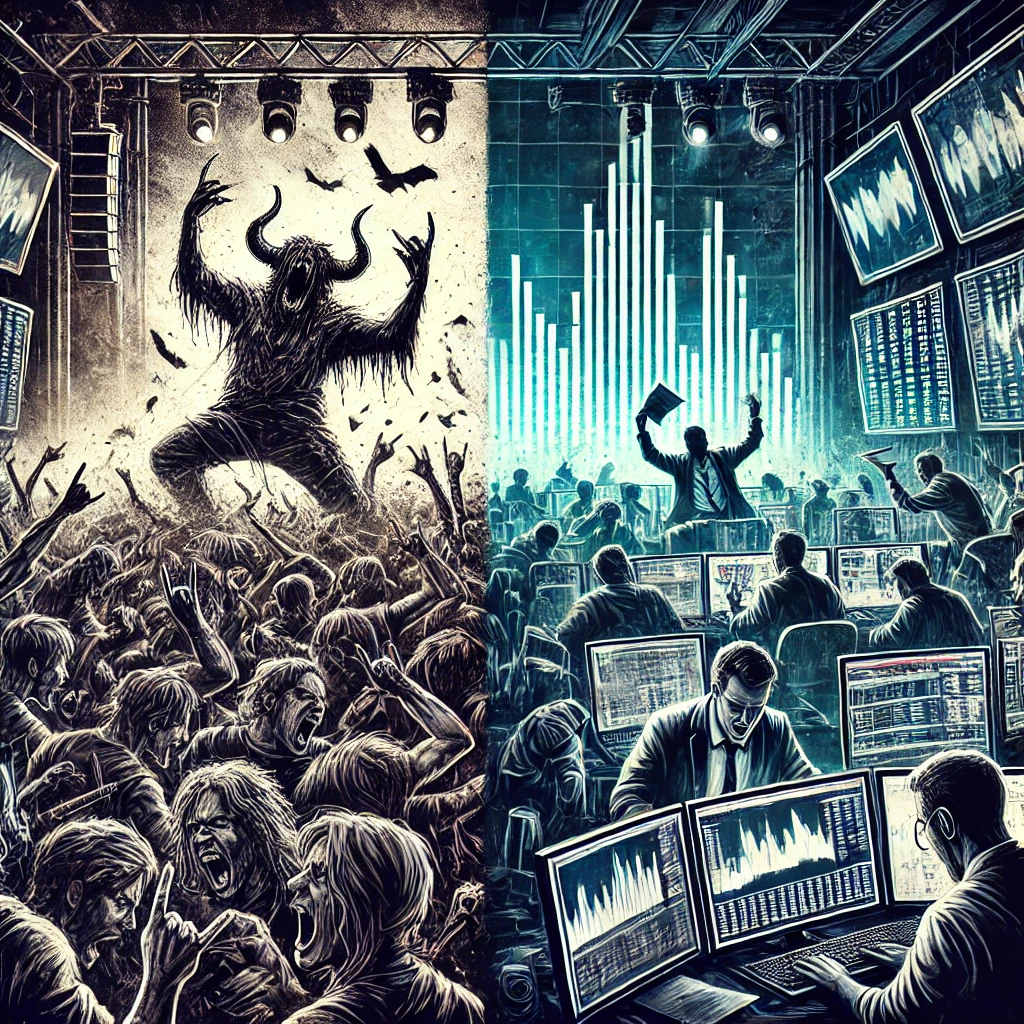
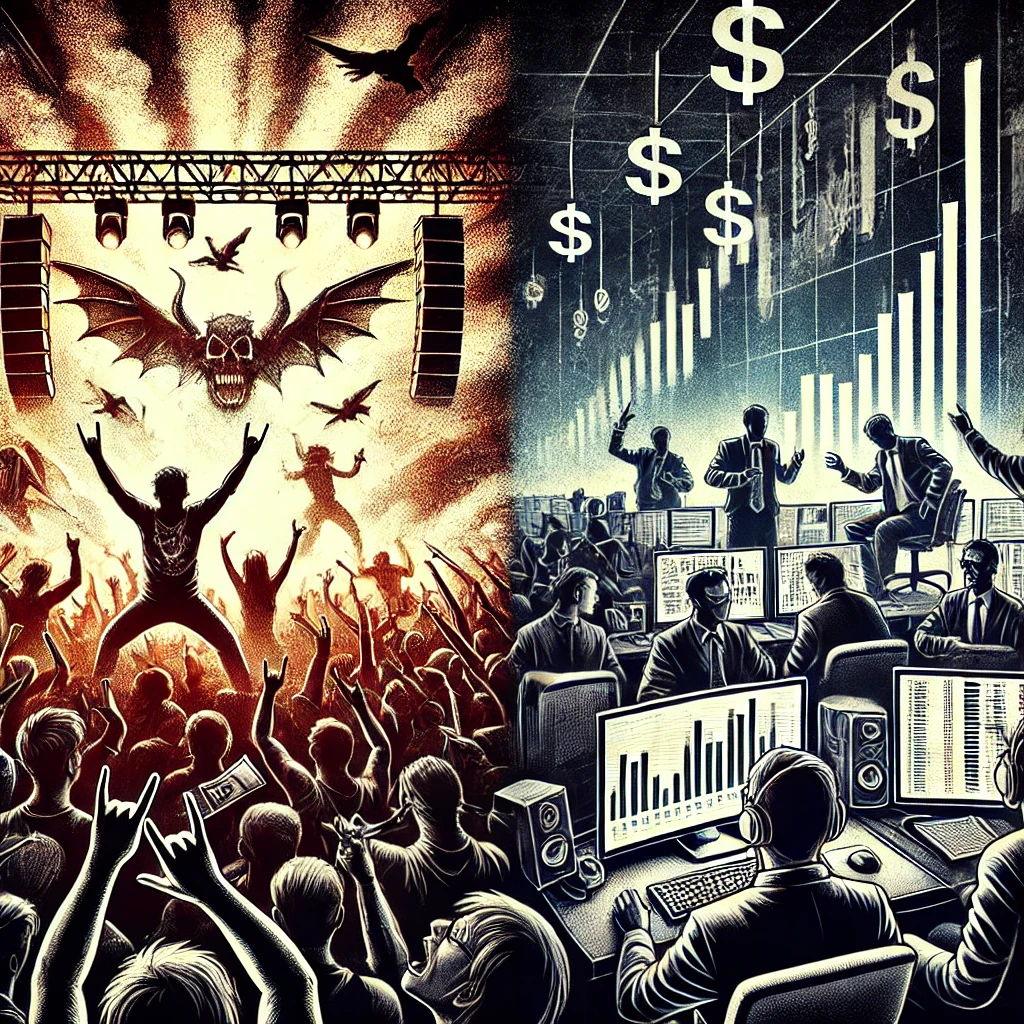
    mosh pit on one side, crowded trading floor on the other, showing parallel chaos
    Two worlds, one shared rush.

    Surviving and Thriving

    Whether you’re swinging your arms in a surge of guitar distortion or firing off trades when a stock gap opens, the same principles apply:

    1. Pick Your Spot
      • In a real pit, you might stand near the edge if you’re less experienced. In the market, you could try conservative plays or watch for clear entry points.
    2. Watch the Signals
      • In a show, the band’s tempo or crowd’s mood can signal a shift. On a trading floor, a notable spike in volume or an extreme jump in price is your warning to move carefully.
    3. Know When to Jump Out
      • Sometimes, the energy is just too volatile. If the market is spiking uncontrollably—like a brutal wall of death—you might want to sidestep until the crowd (or price) settles.
    4. Stay True to Your Style
      • Some people love the pit’s mayhem; others prefer a calmer vantage point. Similarly, some investors chase volatile penny stocks, while others invest in safer, long-term holdings.

    And if you’re feeling extra bold, arm yourself with a manly coffee mug that suits your fearless approach. Because let’s be honest: if you’re going to dive into the chaos, you might as well caffeinate with an attitude.

    From circle pits to market fits, crowd psychology remains a driving force behind our most intense experiences. We feed off each other’s adrenaline, and whether that results in euphoria or a blindsided takedown depends on how prepared we are. Recognizing the parallels between a raucous concert floor and a frenzied trading session is more than just a fun metaphor—it’s a reminder that we’re all wired to sync up with the energy around us.

    So next time you see a stock surging or a crowd swirling, remember the pit rules: stay aware, ride the energy, and know when to step aside. Keep your eyes open, your stance solid, and your rebellious spirit intact. Who knew the secrets to mastering the markets might be found amid the roar of guitars and the crush of bodies?

  • Grindcore & Grind Savings: Making Sense of Micro-Investing Apps Over Your Morning Brew

    Grindcore & Grind Savings: Making Sense of Micro-Investing Apps Over Your Morning Brew

    Raw Energy Meets Small Steps

    Grindcore music isn’t about half-measures—just like metal’s most ferocious subgenre, it’s fast, loud, and relentless. Meanwhile, micro-investing is all about little steps that can build into something massive over time. At first glance, these two worlds couldn’t be more different. Yet if you’re the type to blast unrelenting riffs first thing in the morning, you might find surprising harmony in sipping coffee and automating your spare change into investments. According to NerdWallet, small amounts can compound into significant gains if you stay consistent—much like how tiny bursts of grindcore brutality can form an entire blistering set.

    Morning Brew and Micro-Investing

    Traders often fixate on large-cap stocks and day trading, but micro-investing apps let anyone dip into the market at their own pace. You link a debit card, and every time you buy groceries or snag coffee beans, the app rounds up the purchase and invests the difference. It’s effortless—like a background drum track hammering away while you sip your morning brew. If you want to add a bit more of that rebellious flair to your setup, consider raising a coffee mugs for traders that reminds you to keep grinding (and HODLing) for the long haul. Because even a handful of cents here and there can stack up when you’re consistent.

    Why Grindcore? Why Micro-Investing?

    Grindcore thrives on a do-it-yourself ethos. Bands record in makeshift studios, distribute music through underground channels, and book shows in basements or tiny clubs. Micro-investing apps likewise dismantle barriers to entry. You don’t need thousands of dollars to start—just a smartphone and a willingness to funnel spare change into an ETF or stock slices. Both worlds reject the gatekeeping that says you have to be “rich” or “polished” to participate. The Wall Street Journal once reported on how micro-investing democratizes the market, pulling in folks who might otherwise be sidelined. Just as grindcore invites fans to create their own intense, no-frills music, micro-investing invites everyday people to build wealth incrementally.

    Steps to Get Grinding with Micro-Investing

    Pick an App: Choose a reputable micro-investing platform. Research its fees, user interface, and whether it aligns with your investment preferences.

    Link Your Card: Allow round-ups or periodic transfers. Even one dollar a day can evolve into a considerable stash over time.

    Set and Forget: Like the relentless beat of a grindcore track, consistency is key. You don’t need to tweak the settings daily—just trust the process and occasionally check your balances.

    Channel the Grind: Throw on your favorite blast beat track while you finalize your settings—let the unrelenting drums remind you that little increments, repeated often, become unstoppable momentum.

    Sustaining the Groove

    Maintaining your enthusiasm for micro-investing can be tricky if you’re not seeing big returns right away. Yet the same can be said for discovering a new grindcore band—you might not love it instantly, but over time, the intensity clicks, and you’re hooked. If motivation slips, spice up your coffee routine. Sip from a mom coffee mug just to keep things ironically fun and remind yourself that even a metalhead can have that everyday, caring side. Balance the comedic mug choice with a fierce approach to saving, because the more you treat investing like a daily habit, the more natural it becomes.

    Surviving the Daily Grind (and the Grindcore)

    Every band has off days; every investor sees red in their portfolio at some point. The micro-investing mindset helps you push through. When your spare change invests automatically, you aren’t wrecking your budget or panicking over daily fluctuations. It’s like background noise that eventually builds a massive wall of sound—except this wall of sound can translate to a growing balance over months and years. CNET emphasizes how automating finances helps people save without overthinking. And if the markets tank, you can treat it like a brutal breakdown in a grindcore song—part of the experience, not the end of the world.

    Why It All Works

    Grindcore and micro-investing might sound like a bizarre combo, but they share core principles: efficiency, repetition, and an unyielding spirit. Grindcore condenses songs into short bursts of aggression; micro-investing condenses wealth-building into manageable daily increments. Both rely on consistent, relentless motion. If you can embrace such intensity in your playlist, you can embrace a slow-and-steady investment strategy without losing that rebellious spark. Each round-up deposit is like a blast beat—tiny, fast, and cumulative. Over time, those blasts form a full track, and those deposits form a respectable portfolio.